Ecommerce
AI Try-On vs. Traditional Product Previews
Compare AI try-on vs static product previews — pros, costs, device needs, and impacts on conversions and return rates for online retailers.

When shopping online, one of the biggest challenges is knowing if a product will meet your expectations - especially for items like clothing or cosmetics. Two main methods aim to solve this issue: static product previews (like model photos or 360-degree spins) and AI-powered try-on tools (which let you see products on your own body or a virtual avatar). This is made possible by how virtual try-on technology works, using AR to map features in real-time.
Here’s the quick takeaway:
Static previews are simple and widely used but lack personalization, often leading to uncertainty about fit and style.
AI try-on tools use augmented reality and advanced algorithms to provide lifelike previews tailored to you, reducing returns and boosting purchase confidence.
Key Stats:
AI tools can reduce return rates by 20–30% and increase conversions by 20–94%.
Static previews are cheaper upfront but less effective at addressing fit issues, which cause up to 40% of returns in categories like clothing.
Quick Overview:
Static Previews: Best for simplicity, low cost, and universal device compatibility.
AI Try-On: Ideal for personalization, reducing returns, and increasing sales but requires modern devices and higher setup costs.
AI try-on tools are gaining traction, especially for fashion and beauty retailers, due to their ability to improve customer confidence and satisfaction. Let’s explore how these methods differ and when each makes sense for your business.
What Are Traditional Product Previews?
Traditional product previews have been a staple for online shopping, offering static visuals to help customers evaluate products. These typically include professional photos taken from multiple angles, zoom features for close-up details, and 360-degree product spins. Some even go a step further with 3D images that allow rotation on multiple planes, giving top, bottom, and side views. These tools are especially useful during the “information search” and “alternative evaluation” stages of shopping - phases that often take up the bulk of a shopper’s decision-making time. For example, zoom features are great for examining intricate details in electronics or shoes, while 360-degree spins are ideal for showcasing backpacks or packaged goods. While these methods are helpful, they also highlight the static nature of traditional previews compared to the interactive possibilities of AI-driven tools.
Basic Features of Traditional Previews
Most sellers rely on professional photography to display their products, often using standardized models or flat-lay shots against neutral backdrops. Picture a jacket perfectly lit and styled on a model. Zoom tools allow shoppers to inspect fabric textures or hardware finishes, while 360-degree spins provide a rotational view to make the product feel more tangible.
However, these features only offer a one-way experience. Shoppers can view the product, but there’s no way to interact with it or see how it might suit their unique preferences, such as body type, skin tone, or personal style. The experience is uniform for every customer, which limits its effectiveness.
Main Limitations of Traditional Previews
The static nature of traditional previews creates several challenges. One major issue is their inability to address individual fit and styling needs, leading to a gap in customer trust. For example, between 20% and 40% of e-commerce returns are due to fit issues, with apparel-specific return rates reaching as high as 30% to 40%. Static images simply don’t provide enough information about how clothing will drape or fit on a real person. As Rajashree Goswami from CTO Magazine explains:
“The fashion industry has long struggled with one central flaw of e-commerce: clothing still needs to be experienced, not only viewed. Fit, texture, proportion, and personal style never fully translate through static imagery.”
This lack of personalization also contributes to what researchers call “quality uncertainty”. Customers often question whether the item they receive will match the polished, idealized version they saw online. This skepticism is why 93% of consumers turn to peer reviews for validation, and 82% specifically read reviews to reduce the risk of disappointment.
Another issue is the growing expectation for personalized shopping experiences. A staggering 71% of consumers now expect interactions tailored to their needs. Traditional previews, which often operate in isolation and sometimes provide inconsistent product details across platforms, fall short of meeting these expectations. This is particularly problematic for “experience goods” like clothing and cosmetics, where texture, fit, and feel can’t be assessed until after purchase.
The result? Many shoppers resort to bracket ordering - buying the same product in multiple sizes and returning the ones that don’t fit. This not only creates frustration but also adds unnecessary costs for both consumers and sellers when products fail to meet expectations.
How AI Try-On Tools Work Differently
AI-powered virtual try-on tools are reshaping online shopping by making it more personal and interactive. Instead of relying on generic models that leave you guessing, these tools let you visualize how a product looks on your own body. This shift brings a whole new level of confidence to the shopping experience.
The AI Try-On Process
For shoppers, the process is seamless: Upload a single photo, and within about 6.4 seconds, the AI generates a photorealistic image of you wearing the product.
Behind the scenes, the magic happens through two neural networks working together. One processes the image of the garment, while the other analyzes your photo. Using cross-attention, they create a realistic final image. As Ira Kemelmacher-Shlizerman, Principal Scientist at Google Shopping, describes:
“We were committed to generating every pixel of a garment from scratch to produce high-quality, realistic images.”
What sets this technology apart is its ability to simulate fabric physics. The AI can distinguish how different materials - like cotton, silk, denim, or leather - drape and move. So, instead of a flat image, you see how the fabric would realistically fold, flow, or stretch on your body. This level of detail reduces surprises after purchase by setting clear expectations.
Looksy, for example, offers a privacy-focused virtual try-on tool for Shopify. It works directly in your browser, requires no downloads or sign-ups, and processes images securely without storing them.
This precise simulation of fabric behavior isn’t just a technical achievement - it delivers real benefits for shoppers.
Key Advantages of AI Try-On
These hyper-realistic previews do more than just look cool - they build trust and drive results. Shopify data shows that AR-powered try-ons can increase conversion rates by up to 94% and boost customer engagement by at least 200%. Even more impressively, 98% of users say these tools directly influenced their decision to buy.
AI try-on tools also address a major frustration for online shoppers: 59% of people are dissatisfied when items don’t match their expectations upon arrival. By offering accurate, personalized previews, these tools close the gap between polished product photos and the reality of wearing the item. This is especially valuable in fashion, where poor fit accounts for 70% of online returns. By aligning online previews with real-world experiences, these tools enhance trust and reduce the hassle of returns.
Side-by-Side Feature Comparison
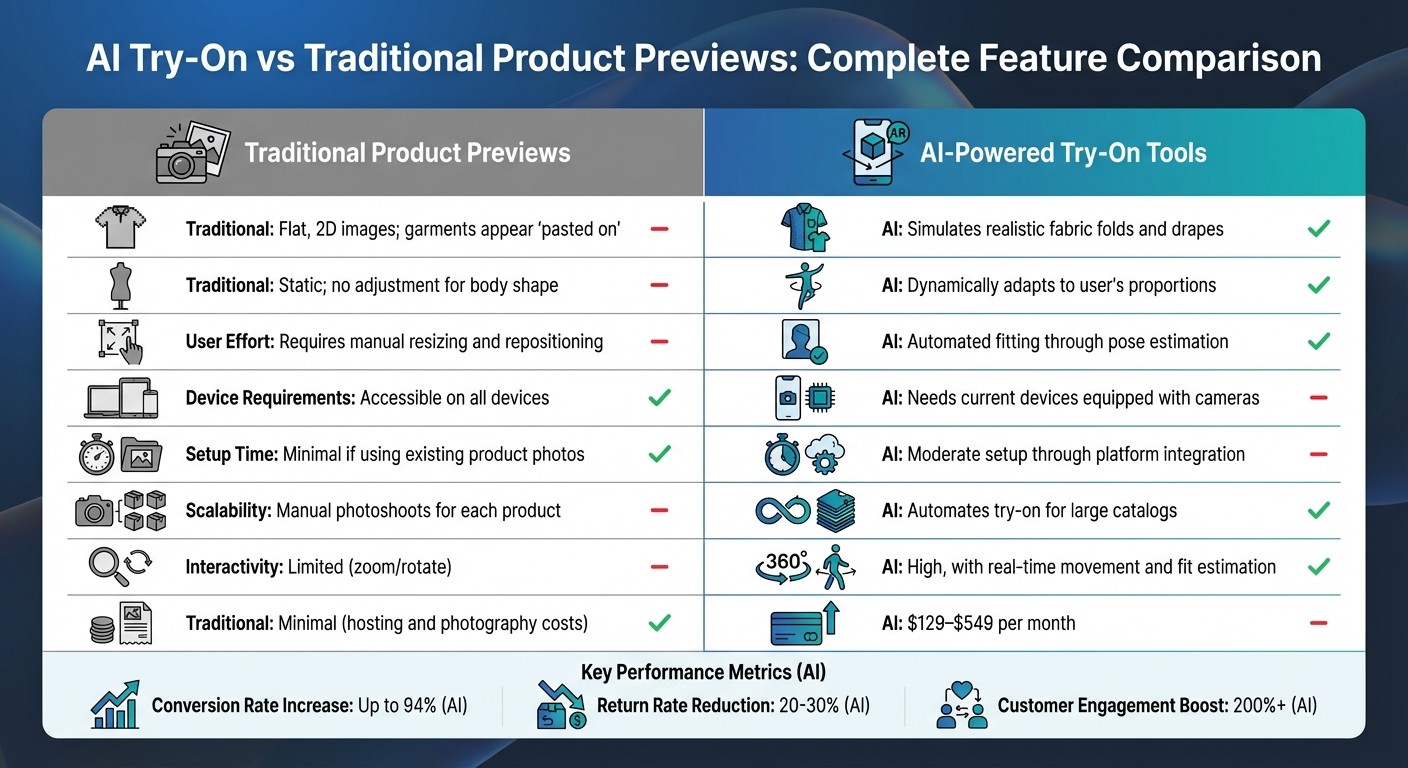
AI Try-On vs Traditional Product Previews: Feature Comparison Chart
Strengths and Weaknesses of Each Method
Traditional previews are straightforward, quick to load, and compatible with all devices. They typically offer static images, size charts, and zoom features. However, they fall short in personalization because they don’t adapt to an individual’s body shape, leaving consumers guessing about how well a garment will actually fit.
On the other hand, AI try-on tools use pose estimation and 3D mapping to overlay clothing onto a user’s body. These tools excel at automating fit adjustments, eliminating the risk of manual errors. But they do come with requirements - modern devices with cameras and a stable internet connection are essential for running the necessary deep-learning algorithms. Jinder Kang from Netguru highlights a potential downside:
“A poorly orchestrated try-on could actually discourage a consumer instead of helping them make a purchase decision”.
The choice between these methods boils down to priorities. Traditional previews emphasize accessibility, while AI try-on tools focus on precision and engagement. Interestingly, retailers using AI try-on technology have reported conversion rate boosts of up to 94% (calculate your potential Virtual Try-On ROI). The following table highlights the key differences.
Detailed Comparison Table
Feature | Traditional Product Previews | AI-Powered Try-On Tools |
|---|---|---|
Visual Quality | Flat, 2D images; garments can appear “pasted on” | Simulates realistic fabric folds and drapes |
Body Adaptation | Static; no adjustment for body shape | Dynamically adapts to the user’s proportions |
User Effort | Requires manual resizing and repositioning | Automated fitting through pose estimation |
Device Requirements | Accessible on all devices | Needs current devices equipped with cameras |
Setup Time | Minimal if using existing product photos | Moderate setup through platform integration , such as when you add virtual try-on to a Shopify store |
Scalability | Involves manual photoshoots for each product | Automates try-on for large catalogs |
Interactivity | Limited (e.g., zoom/rotate) | High, with real-time movement and fit estimation |
Monthly Cost | Minimal (mainly hosting and photography costs) | $129–$549 per month |
Effects on Sales and Return Rates
How AI Try-On Increases Conversions
AI try-on tools are reshaping the online shopping experience by offering shoppers a personalized way to preview products before purchasing. This tailored approach not only enhances the shopping journey but also fosters a sense of confidence in buying decisions. Retailers using these tools have seen impressive results. For example, Good American reported a 30–40% increase in conversions after showcasing products on various body types through virtual try-on. Similarly, Eileen Fisher experienced a 272% boost in conversions and a 258% jump in average session duration when they introduced an AI-powered mix-and-match styling tool.
Warby Parker‘s mobile AR try-on feature, which uses Apple’s ARKit to adapt frames to each shopper’s unique facial structure, led to an 85% conversion increase among engaged users. By offering a clear and realistic preview of how products will look or fit, these tools reduce hesitation and reinforce purchase confidence. And when shoppers feel more certain about their choices, returns naturally decrease.
Lower Return Rates with AI Try-On
The same technology that drives higher conversions also helps cut down on return rates. Traditional online apparel shopping often struggles with returns, which average around 24.4%. AI try-on tools tackle this issue by providing detailed, realistic previews, leading to a 20–30% reduction in return rates.
Warby Parker’s virtual try-on users, for instance, saw return rates drop to below 2%. Macy’s experienced similar success, with customers using their virtual try-on feature also reporting return rates under 2%. These tools offer shoppers a better understanding of how items will look and feel, showing details like how fabrics drape or move on their bodies. This clarity results in more informed purchases, fewer returns, and significant cost savings in shipping and logistics. For Shopify stores using Looksy, these benefits directly impact profitability while delivering a smoother, more satisfying shopping experience.
How Better Previews Build Customer Trust
Personalized and Interactive Shopping
AI-powered try-on tools are transforming shopping into a more engaging experience. Instead of relying on generic models that don’t reflect individual features, shoppers can now see how products look on their own body shape, skin tone, and other unique characteristics. These tools analyze over 100 factors - like skin tone and hair color - to suggest options that complement each person best. Generative AI even replicates the way fabrics move, adding a layer of realism.
Some tools go beyond basic overlays by offering “constructors”, which let customers adjust colors or patterns and instantly see the changes on their own images. This level of personalization not only enhances the shopping experience but also builds trust between customers and brands.
Augmented reality (AR) try-on experiences have been shown to increase customer engagement by over 200%. Retailers are now positioning these tools as “styling assistants” rather than just virtual try-on or size chart fit solutions, encouraging users to explore and interact more deeply with their brand. As Dorian Dargan, Co-founder and CEO of Doji, explains:
“If you’re primarily just focused on returns and conversion, you might miss that opportunity around inspiration and exploration”.
However, personalization alone isn’t enough to secure trust - protecting customer data is equally important, as discussed next.
Privacy Protection and Customer Trust
While personalization strengthens engagement, ensuring robust privacy practices is critical for maintaining customer trust. If personal photo data isn’t secure, trust erodes. A significant hurdle to adopting virtual try-on technology is the concern over privacy, especially regarding sensitive body information. This creates what’s known as a “privacy paradox”, where customers want better-fitting products but hesitate to share personal data.
Looksy tackles this issue with a privacy-first approach. Instead of storing raw user photos, the platform only retains derived data, such as body measurements and landmarks. By eliminating the need for downloads or sign-ups, it minimizes the amount of personal information collected. Additionally, clear consent flows outline exactly what data is gathered and how long it will be stored, using straightforward language. The entire process complies with global privacy standards like GDPR and CCPA, ensuring customer data remains secure.
Transparency is key. A majority - 59% - of shoppers prefer clear labeling of AI-generated imagery, viewing this openness as a sign of honesty and accountability. Retailers that empower users with control over their data, such as options to modify or delete avatars, enhance trust. As Jen Jones, Chief Marketing Officer at Commercetools, points out:
“People who would have never ever uploaded a selfie of themselves to something like [Google’s] Gemini two years ago would do it without thinking twice today”.
This growing trust in AI technology reflects a shift in consumer attitudes - provided companies handle data responsibly.
Cost and Setup Requirements
AI try-on tools don’t just help boost conversions and cut down on returns - they also offer a much more budget-friendly and efficient alternative to traditional methods.
Initial and Monthly Costs
Traditional product photography can be a massive expense. A professional fashion photoshoot typically costs between $2,000 and $15,000 per session, with mid-range shoots running $5,000–$10,000 for about 100 images.
AI try-on tools completely change this pricing model. For instance, Looksy’s Starter plan costs just $14.99 per month, covering 100 photo try-on credits, with additional credits priced at $0.14 each. Their Scale plan, at $79 per month, includes 600 photo or video credits, with extra usage charged at $0.10 per credit. Compare this to traditional photography, which costs $20 to $150 per SKU, and you’ll see why brands using AI photography report an average cost reduction of 87%. The savings grow even more with larger catalogs. For example, photographing 1,000 products using traditional methods could cost $50,000 to $100,000. With AI tools, that same task might cost just $280 to $1,500, slashing expenses by over 99%.
Setup Time and Integration
Traditional photography isn’t just expensive - it’s also time-consuming. It typically takes 20–40 hours of planning and has a 2–4 week turnaround time, with 15–20% of shoots requiring reshoots. On the other hand, Looksy’s Shopify integration allows teams to get started in just 1–2 days, and AI-generated results appear in as little as 15 seconds. This eliminates the need for shipping samples, booking studios, or coordinating with multiple vendors. The result? Faster product launches and the ability to quickly update seasonal collections without the usual logistical headaches. With such streamlined processes, AI tools make it easier than ever to stay agile in a fast-paced market.
When to Use AI Try-On Instead of Traditional Previews
AI try-on tools shine in situations where traditional product photos fall short. By speeding up processes and reducing costs, they’ve proven their worth in boosting conversions and cutting down return rates. Let’s explore the scenarios where this technology delivers the most impact.
Best Scenarios for AI Try-On
High-volume fashion retailers benefit significantly from AI try-on tools. If you’re frequently updating your inventory with new styles, colors, or seasonal collections, traditional photography can slow you down. AI try-on eliminates the need for constant reshoots, allowing you to launch products faster while keeping expenses steady.
Luxury and premium fashion brands also gain an edge with AI try-on. These brands often need to highlight intricate details like fabric drape, embellishments, and textures to maintain their high-end appeal. Digital twins created with AI provide a detailed, personalized preview without compromising on quality. Uri Minkoff, Cofounder and CEO of Rebecca Minkoff, puts it perfectly:
“3D media makes for a much more interactive shopping experience. Customers can examine our products from every angle… which helps them get a better sense of quality, size, and other details that matter”.
Product categories with high return rates - think denim, tops, or eyewear - are ideal for AI try-on. These categories often see returns due to fit issues, but AI try-on can reduce uncertainty, improve ROI, and boost CTR. The interactive experience builds customer confidence, which translates to fewer returns and more satisfied buyers.
To make the most of this feature, include clear calls-to-action like “Try It On Now” prominently on your product pages. Placing this above the fold ensures customers notice it, encouraging them to engage with the tool and boosting conversions.
Looksy Plans and Features
Looksy caters to businesses of all sizes with flexible pricing plans. Here’s a breakdown of their offerings:
Free Plan: Unlimited try-ons, up to $100 of additional revenue, with Looksy branding.
Starter Plan: $14.99/month for 100 photo try-on credits, and removes Looksy branding.
Growth Plan: $29/month for 300 photo try-on credits.
Scale Plan: $79/month for 600 photo or video credits, plus realtime video try-on.
All plans include essential features like instant results, privacy-focused design, and seamless Shopify integration. Plus, there are no downloads or sign-ups required for your customers.
Still unsure if AI try-on is right for your business? Looksy offers a free plan with unlimited try-ons, allowing you to test the technology risk-free before making a commitment.
Choosing the Right Preview Method for Your Store
Deciding between traditional product previews and AI-powered try-ons depends on understanding what your customers need and what your business can handle. Traditional methods like static photos, size charts, and on-model images work well for basic displays. However, they often leave shoppers uncertain, leading to higher return rates. This opens the door for a more advanced solution that not only reduces uncertainty but also simplifies setup and cost management.
Looksy’s AI try-on swaps out generic images for personalized previews, helping shoppers feel confident in their choices. That added confidence is exactly what reduces style-related returns. For Shopify stores struggling with high return rates - especially in categories like tops or eyewear - AI try-on can quickly demonstrate its value. Personalized previews not only enhance the shopping experience but also represent a step forward from traditional methods.
What makes Looksy even more appealing is its smooth Shopify integration. The platform automatically adapts to your store’s theme for a cohesive brand experience. Plus, its asynchronous loading allows customers to upload a photo and see instant results - no downloads or sign-ups required.
Still unsure? Looksy offers a free plan with unlimited try-ons so you can test it out. Start with a single high-return category to see how it impacts conversions and return rates. This low-risk trial could save you significantly compared to the ongoing costs of high returns.
With the National Retail Federation predicting an online return rate of over 19% by 2025, every return you prevent saves money and builds customer trust. For Shopify stores aiming to lower returns and increase fashion store conversion rates, AI try-on is a game-changer.
FAQs
How accurate is AI try-on for fit and drape?
AI try-on systems rely on cutting-edge tools like deep learning, 3D modeling, and image depth estimation to predict fit and simulate how fabrics will drape. These technologies aim to provide a more accurate representation of how clothing or accessories might look and feel. That said, the precision of these systems can differ based on the specific methods or algorithms in use. While they are incredibly advanced, the results might not always align perfectly with real-world outcomes.
What do customers need to use AI try-on?
Using AI try-on is straightforward. Customers just upload a photo of themselves, and the tool works its magic by overlaying digital products onto their image. This gives them an instant, personalized preview of how the items might look on them.
How does AI try-on protect my photo privacy?
AI try-on ensures your photo privacy by handling image processing directly on your device in real-time. None of your personal data is stored or shared, and all visual information is erased as soon as you close the browser tab.