Ecommerce
Best Customer Experience Tools for Fashion Stores
AI virtual try-ons, shopping assistants, and personalization engines that cut returns and boost conversions for fashion eCommerce stores.
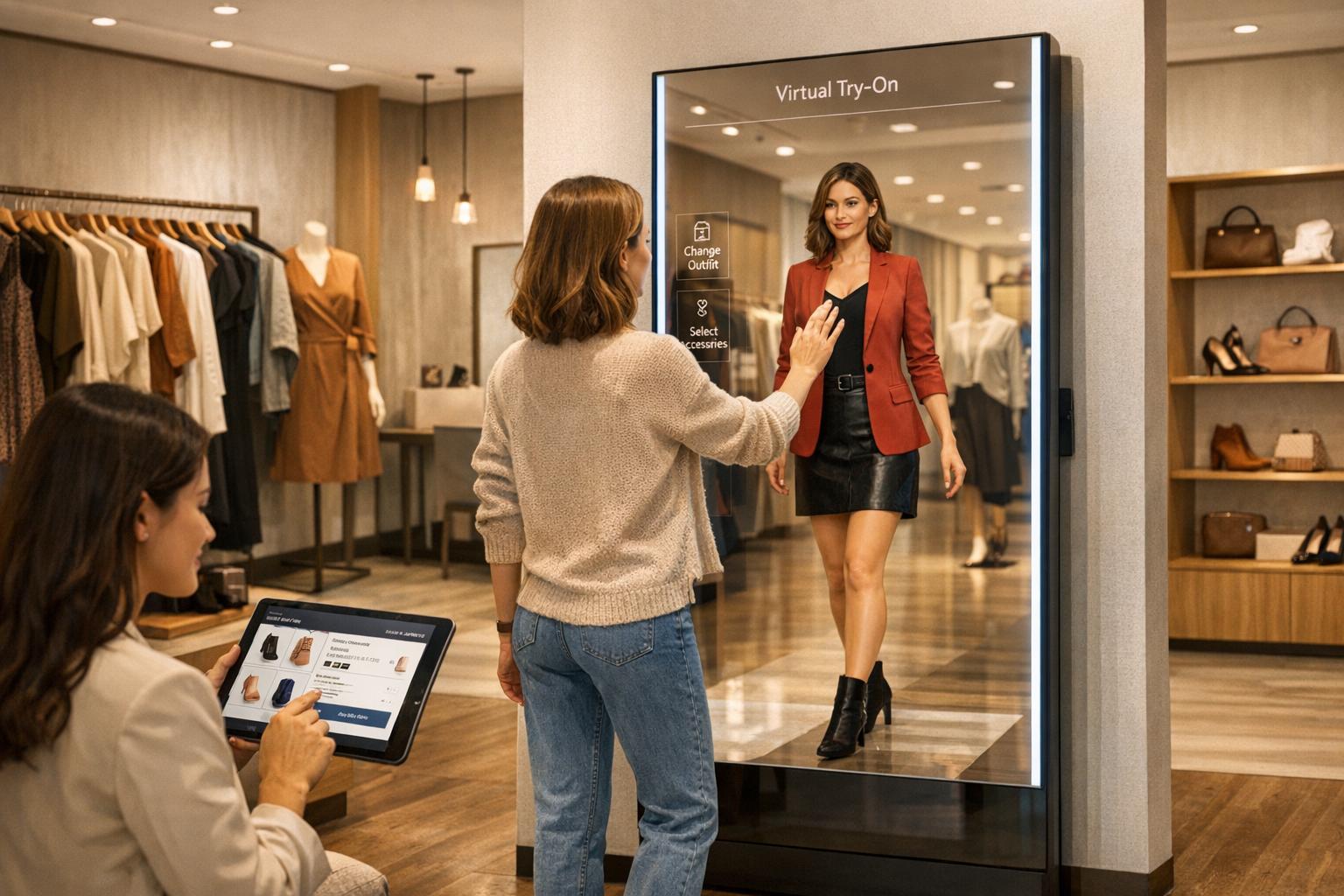
Fashion eCommerce faces a major hurdle: customers can’t try on items before buying, leading to high return rates - nearly 19% by 2025. Tools like AI virtual try-ons, shopping assistants, and personalization engines are helping Shopify fashion retailers combat this issue, boosting sales and reducing returns.
AI Virtual Try-On: Lets shoppers see how clothes look on them. Helps shoppers judge fit and style before they buy. Plans start with a free tier, then $14.99/month.
AI Shopping Assistants: Provide instant support for sizing, fabric, and more. Boost conversions by up to 69% and are free with Shopify Inbox.
Personalization Engines: Predict customer preferences and recommend products. Increase order value by 40%-58%. Cost ranges from $129-$549/month.
These tools not only address fit concerns but also improve the online shopping experience, making them essential for fashion retailers aiming to cut costs and increase revenue.
1. Looksy AI Virtual Try-On
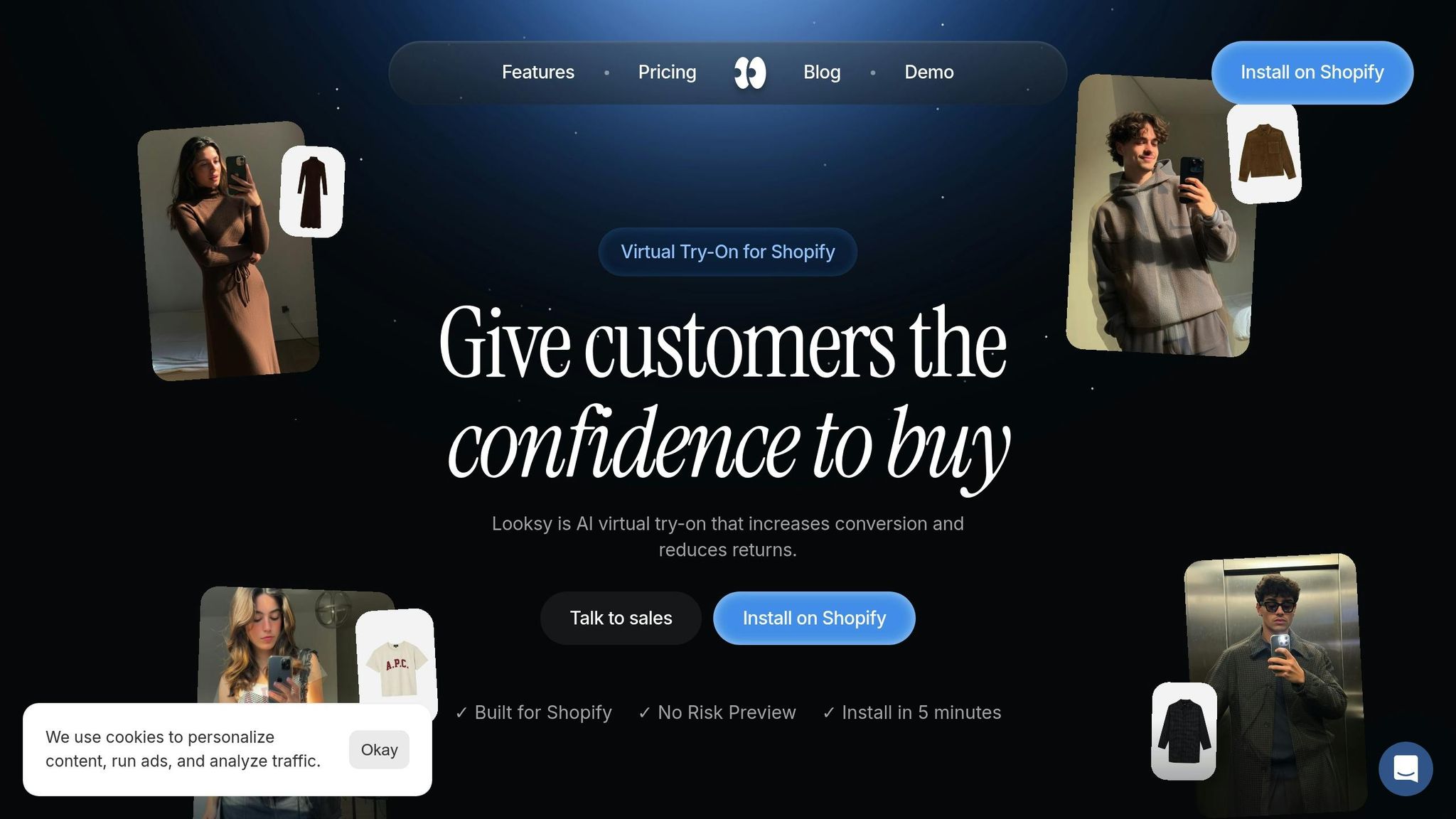
Looksy is a browser-based AI virtual try-on tool designed for Shopify stores. It allows customers to upload a selfie and instantly preview how clothing looks on them - no downloads or sign-ups required. The tool processes images in about 3 seconds, helping shoppers make purchase decisions in as little as 15 seconds.
Setting up Looksy is quick and straightforward, taking just five minutes with a one-click installation process. It uses non-blocking JavaScript, ensuring your site speed remains unaffected. Plus, photos are securely processed through an API and are not stored, addressing privacy concerns effectively.
Impact on Conversions
Looksy does not publish conversion benchmarks, so the lift is something each store should measure for itself. Track how many visitors open the try-on and whether those sessions convert more often than the rest.
Effect on Returns
By allowing customers to see how items fit and look before buying, Looksy helps reduce the need for ordering multiple sizes to compare at home. Looksy has no published returns figure, so compare your own size-related return rate before and after switching it on.
Integration with Shopify

Looksy integrates seamlessly with Shopify, automatically adapting to your store’s CSS to ensure a consistent brand experience. A “Try On” button is added directly to product pages, minimizing friction for customers. For high-volume stores, Looksy includes a built-in calculator to estimate monthly try-ons and select the most suitable pricing tier. Every paid plan removes Looksy branding and unlocks unlimited size, bundles, and email capture, and the Scale plan adds realtime video try-on.
Pricing in USD
Plan | Monthly Cost | Included Try-Ons | Overage Fee |
|---|---|---|---|
Free | $0 | Unlimited try-ons | None |
Starter | $14.99/month | 100 | $0.14 |
Growth | $29.00/month | 300 | $0.12 |
Scale | $79.00/month | 600 | $0.10 |
Looksy offers a free plan with unlimited try-ons, capped at up to $100 of additional revenue, allowing retailers to see how well the AI renders their products before committing to a subscription. Additional credits run from $0.10 to $0.14 per try-on, which sits below the industry average of $0.15–$0.36. These pricing options make Looksy an appealing and cost-effective choice for fashion retailers looking to boost online engagement.
2. AI Virtual Shopping Assistants
AI shopping assistants are reshaping how fashion stores interact with customers by offering round-the-clock digital support. These assistants handle common inquiries about sizing, fabric details, return policies, and order statuses - all without the need for human involvement. Using natural language processing, they interpret customer questions and provide instant, personalized answers based on customer data. At checkout, they can even address last-minute concerns to recover abandoned carts, turning hesitation into completed purchases.
Impact on Conversions
Quick responses from AI can significantly boost sales. For instance, faster reply times have been shown to increase conversions by up to 69%. During Black Friday 2024, online retailers using AI chatbots saw a 15% rise in conversion rates. Shopify Inbox has demonstrated its effectiveness in saving sales, delivering strong returns on investment. Similarly, Olive & Piper, a jewelry brand, reported a 35% jump in conversions after introducing AI-powered personalized recommendations through LimeSpot.
Effect on Returns
AI shopping assistants also play a role in reducing product returns. By providing accurate information upfront, they minimize the misunderstandings that often lead to returns. Some brands have seen return rates drop by as much as 45% thanks to AI-powered sizing tools. This is particularly impactful given that 42% of online apparel returns are due to size and fit issues. Addressing these concerns early not only reduces returns but also improves customer satisfaction.
Integration with Shopify
Shopify Inbox, a free messaging tool built directly into Shopify, simplifies customer communication by consolidating chat, social media messages, and email inquiries into one dashboard. It integrates seamlessly with your product catalog and customer profiles, enabling accurate, personalized recommendations without manual effort. For merchants seeking advanced features like AI shade-matching quizzes or predictive outreach for high-value customers, third-party apps can be added via the Shopify App Store.
Pricing in USD
Shopify Inbox is free for all Shopify merchants. For those looking to expand capabilities, third-party AI assistant apps range from $129 to $549 per month, depending on features and usage. High-end options like Obsess, which offers immersive 3D shopping experiences with AI guides, start at $3,000 per month.
3. Product Discovery and Personalization Engines
Product discovery engines take real-time behavioral data - like past purchases, search habits, and browsing patterns - and use it to predict what shoppers might want, often before they even know it themselves. For fashion retailers, this means showcasing relevant styles automatically, cutting down the frustration of scrolling through endless catalogs. Features powered by visual AI, such as allowing customers to upload photos to find similar items or using “Shop the Look” tools to recreate full outfits, make shopping more engaging and seamless. These personalized experiences not only grab attention but also encourage purchases.
Impact on Conversions
Fashion brands leveraging AI-powered visual discovery tools have reported impressive results, with conversion rates increasing by as much as 7.1 times. For instance, Marc Jacobs used Nosto’s AI personalization across its website and email campaigns, which contributed to 9% of the brand’s total online revenue through more intent-driven shopping experiences. Similarly, Rebecca Minkoff integrated 3D media and augmented reality into its online store, leading to a 44% higher likelihood of customers adding items to their carts and a 65% increase in completed purchases. AI personalization doesn’t just boost conversions - it also increases average order value (AOV) by 40% to 58%. Gymshark, for example, uses AI-powered recommendation engines to display “People also bought” and “Frequently bought together” suggestions during checkout, driving additional sales by aligning with customer interests.
Effect on Returns
Personalization engines also play a key role in reducing returns by addressing size and fit concerns before customers check out. By analyzing past purchase and return data, these tools can recommend the right size from the start. Visual AI further helps by showing how items fit and drape on different body types, minimizing mismatched expectations. This approach not only reduces return rates and processing costs but also improves customer satisfaction. In fact, 56% of shoppers say they’re more likely to return to a retailer after experiencing a personalized shopping journey.
Integration with Shopify
Many of the top personalization engines, such as Nosto, Syte, and LimeSpot, offer native Shopify apps that integrate directly into your store without requiring coding skills. These tools work seamlessly with Shopify’s Storefront API and Shopify Flow to automate tasks like product tagging and inventory updates. Nosto, for example, is praised for its easy integration thanks to open APIs and pre-built connectors. To get the most out of these tools, ensure your product metadata - like color codes, materials, and dimensions - is accurate and consistent.
Pricing in USD
For Shopify-compatible AI recommendation and personalization apps, pricing typically falls between $129 and $549 per month. On the other hand, Shopify Magic, which includes basic AI-powered copywriting and personalization features, is available at no additional cost for all Shopify merchants.
Pros and Cons
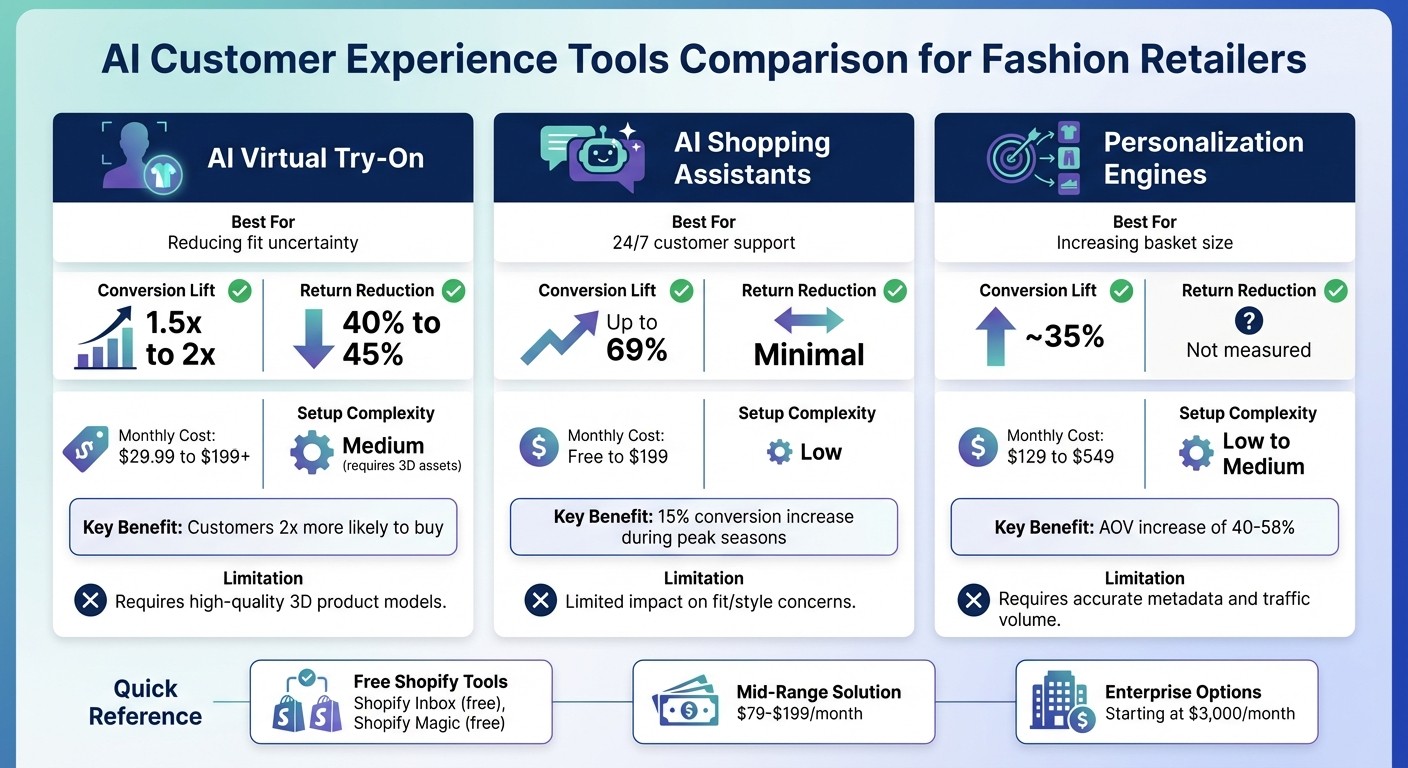
AI Customer Experience Tools Comparison for Fashion Stores
When deciding on the right tools for your business, understanding their strengths and limitations is key to making a smart investment.
AI Virtual Try-On is a game-changer for tackling fit issues. Customers using these tools are twice as likely to buy, and return rates drop by over 40% - a huge win for retailers. On the flip side, these tools require high-quality 3D assets (under 5MB and 50,000 polygons) and an upfront investment in creating detailed product models.
AI Virtual Shopping Assistants shine during busy shopping seasons, like Black Friday, increasing conversions by up to 15%. They’re great for answering customer questions, but they fall short when it comes to addressing fit or style concerns, so their impact on return rates is minimal.
Product Discovery and Personalization Engines help keep customers engaged and encourage larger purchases. Plus, they integrate seamlessly with Shopify. However, their effectiveness depends on having accurate product metadata and enough user traffic to generate meaningful insights. For smaller stores with limited data, the benefits may take time to show.
Here’s a quick overview of how these tools stack up:
Tool Category | Best For | Conversion Lift | Return Reduction | Monthly Cost Range | Setup Complexity |
|---|---|---|---|---|---|
AI Virtual Try-On | Reducing fit uncertainty | 1.5x to 2x | 40% to 45% | Free to $79 | Medium (requires 3D assets) |
AI Shopping Assistants | 24/7 customer support | Up to 69% | Minimal | Free to $199 | Low |
Personalization Engines | Increasing basket size | ~35% | Not measured | $129 to $549 | Low to Medium |
Pricing varies widely. Shopify’s built-in tools, like Shopify Inbox and Shopify Magic, are free options to get started. On the higher end, enterprise solutions like Obsess start at $3,000 per month. For many fashion retailers, a middle-ground solution priced between $79 and $199 per month offers a solid mix of features and affordability.
Conclusion
To tackle the challenges of fit uncertainty, align your technology strategy with the goals of reducing returns and boosting conversions. If high return rates are cutting into your profits, AI virtual try-on technology should be at the top of your list. Studies show it can lead to higher purchase completion rates and reduce returns by over 40%. At just $14.99 per month for the Starter plan, it’s a practical option for small to mid-sized Shopify merchants looking to address fit-related issues. This approach offers a tech-driven way to solve one of the most persistent challenges in online retail.
For those watching their budget, Shopify’s free tools are a great starting point. Shopify Magic helps create SEO-friendly product descriptions, while Shopify Inbox provides round-the-clock automated customer support, which has been shown to boost conversions by as much as 69%.
Mid-sized fashion retailers with well-organized product data and steady traffic should explore personalization tools to drive larger basket sizes. For instance, jewelry brand Olive & Piper saw a 35% conversion increase during their busiest season by leveraging AI-powered product recommendations.
To ensure your investment pays off, track the results. Start with a 30-day pilot targeting your highest-return or best-selling category. Monitor metrics like conversion rates, return reductions, and customer engagement to evaluate the impact. The most successful Shopify merchants in the U.S. adopt technology not for its novelty, but because it solves real problems and delivers measurable returns.
FAQs
How can AI-powered virtual try-on technology help fashion stores reduce return rates?
AI-powered virtual try-on technology lets shoppers visualize how clothes will look and fit on their own bodies by overlaying lifelike, AI-generated images of the garments. This gives customers a clearer idea of size, fit, and style, making it easier for them to shop with confidence.
By addressing uncertainties around fit and appearance, virtual try-ons help lower size-related returns, which not only enhances customer satisfaction but also saves retailers time and money on return processing. This technology is particularly beneficial for online fashion stores looking to elevate the shopping experience and build stronger customer loyalty.
What are the costs and setup requirements for using AI shopping assistants in fashion eCommerce?
The costs and setup requirements for AI shopping assistants depend on the provider and the scale of your eCommerce platform. Generally, you’ll need to account for a subscription fee, which could vary based on usage or included features. Additionally, resources will be required for integration, configuration, and testing.
For a precise estimate, it’s a good idea to reach out to the vendor directly. They can provide detailed pricing and explain any technical requirements. Many providers also offer consultation services to customize the solution for your store, helping to ensure a seamless implementation.
How do AI-powered personalization tools improve customer engagement and sales in fashion eCommerce?
AI-powered personalization tools are transforming how fashion eCommerce connects with customers, offering shopping experiences that feel custom-made. By analyzing factors like browsing habits, purchase history, and even real-time details such as location or device, these tools can recommend products, suggest outfits, and tailor promotions. Imagine a shopper seeing styles, colors, and sizes that perfectly align with their preferences - it’s like having a personal stylist guiding their journey. This boutique-like experience keeps shoppers engaged and encourages them to explore further.
The sales benefits are hard to ignore. Personalization doesn’t just boost conversion rates; it also increases the average order value and helps cut down on return rates by guiding customers toward items that truly suit them. Plus, suggesting complementary pieces - like accessories or matching items - can inspire additional purchases. By making every interaction feel meaningful and relevant, these tools not only strengthen customer loyalty but also create a steady path for revenue growth in the competitive world of online fashion.