Ecommerce
How to Increase Fashion Store Conversion Rates in 2026
Tactics to boost fashion store conversions: improve mobile speed, add AI virtual try-on, simplify checkout, personalize recommendations, and track KPIs.
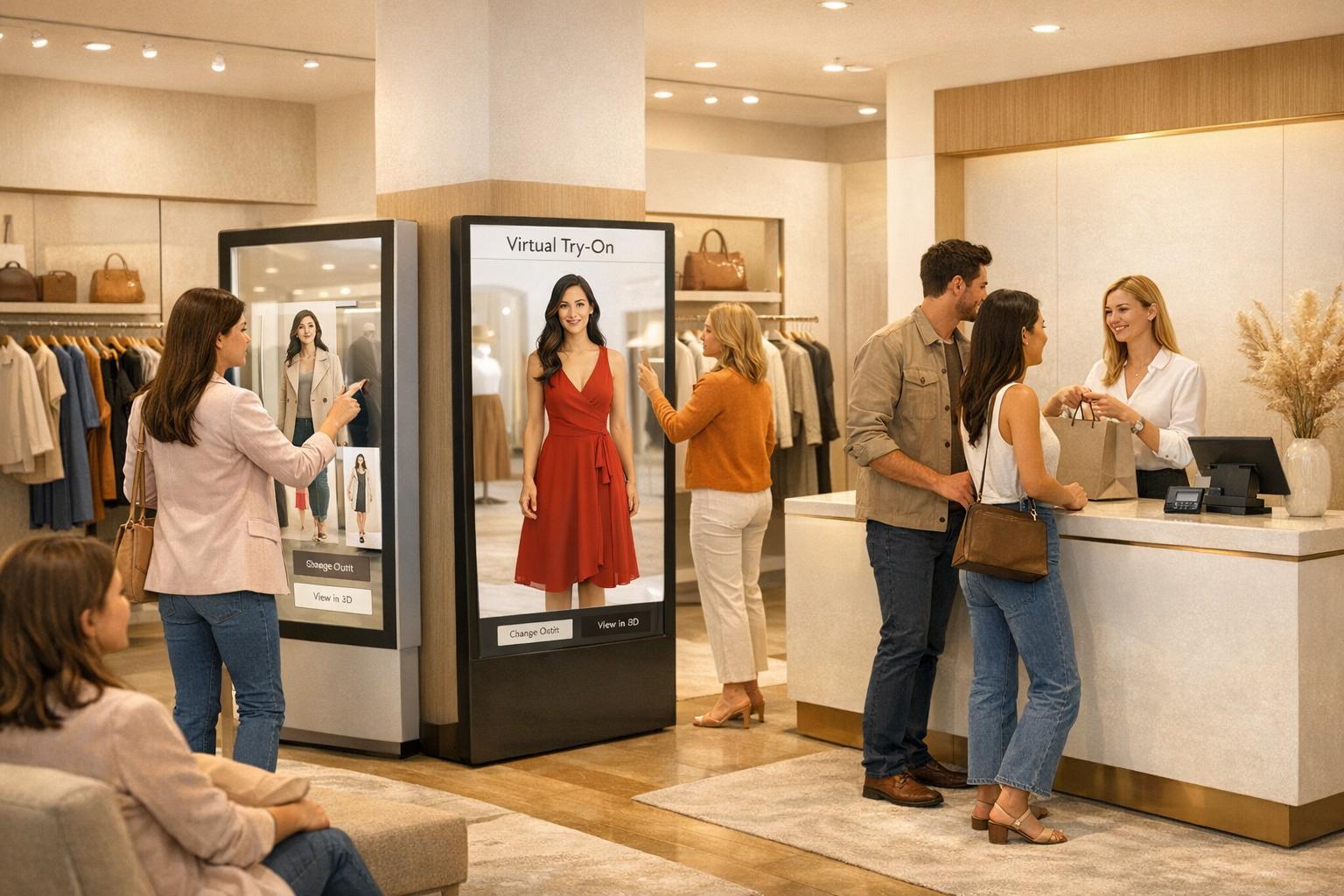
Fashion eCommerce is growing fast, but challenges like high return rates (19%-29%) and mobile cart abandonment (70%) are holding many stores back. With mobile shopping accounting for 80% of visits, slow pages, fit anxiety, and trust issues are costing stores millions. Key strategies to improve conversion rates include:
Use AI Virtual Try-On: Reduce fit concerns with tools that let shoppers see how items look and fit on their body. These features can lower returns and increase buyer confidence.
Optimize Mobile Experience: Ensure your site loads in under 200ms to meet Google’s Core Web Vital metrics. Features like swipe-friendly galleries and sticky “Add to Cart” buttons make shopping easier.
Simplify Checkout: Adopt faster payment options like Shop Pay, which improves checkout-to-order rates by up to 50%.
Leverage Personalization: Offer tailored product recommendations and dynamic sizing suggestions to guide shoppers and increase sales.
Track Metrics: Use Shopify Analytics and tools like heatmaps to monitor conversion rates, return rates, and customer behavior.
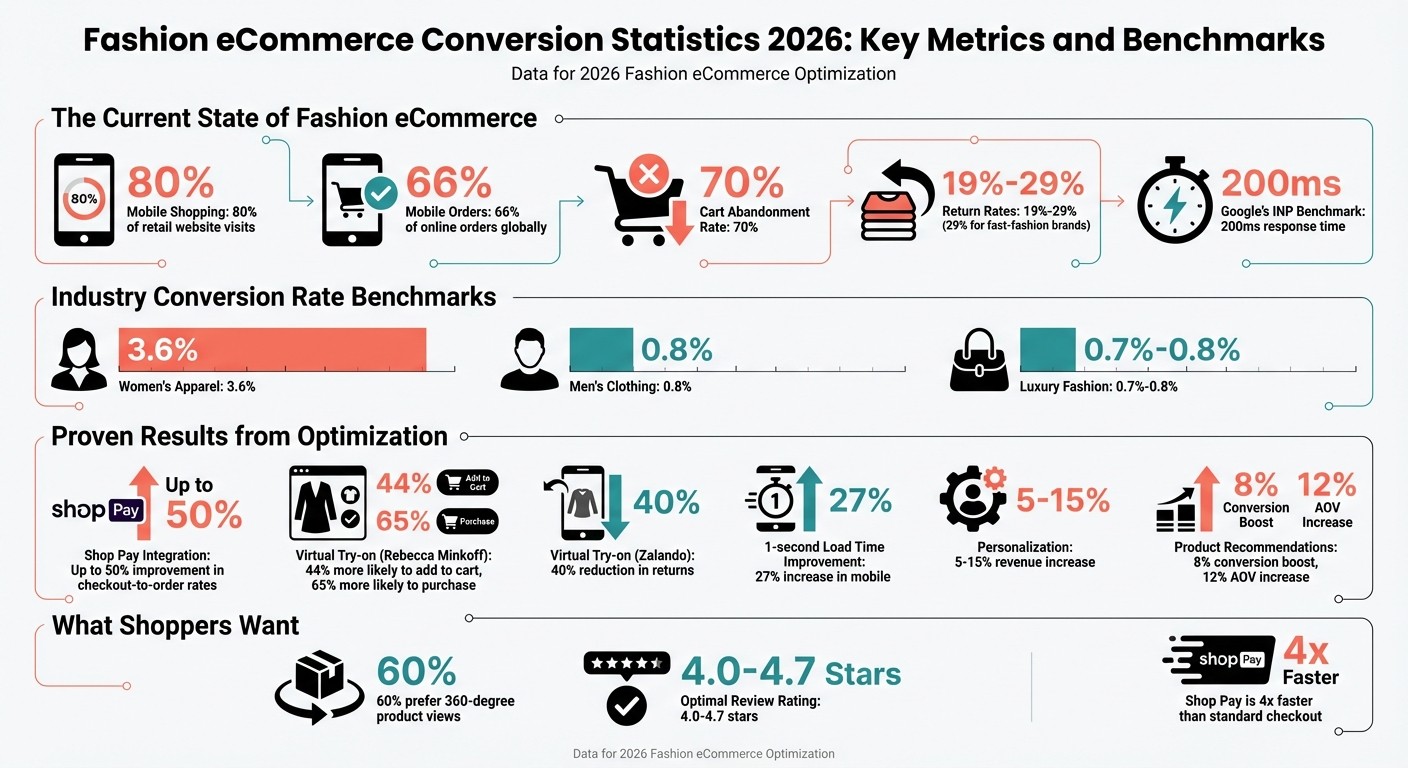
Fashion eCommerce Conversion Statistics 2026: Key Metrics and Benchmarks
Identify Conversion Problems and Set Benchmarks
How to Measure Conversion Rates
To monitor conversion rates in Shopify, head to Analytics > Reports > Behavior and open the Conversion rate breakdown report. This tool highlights exactly where shoppers drop off - whether they’re browsing products without adding them to their cart or leaving during checkout.
Break down your data by device type, traffic source, and audience to pinpoint problem areas that need deeper analysis. Beyond Shopify’s built-in analytics, tools like heatmaps and session recordings can give you a closer look at how shoppers interact with your site. For example, platforms like Lucky Orange (starting at $19/month) can reveal “rage clicks” on unresponsive elements and show how far users scroll before they exit. To go even further, consider hiring testers to complete specific tasks - like navigating, selecting sizes, and checking out - while narrating their experience. This hands-on feedback can uncover usability issues that analytics alone might overlook.
Armed with this data, you can identify the exact conversion problems impacting your store.
Common Conversion Problems in Fashion eCommerce
One of the biggest hurdles for online fashion retailers is fit anxiety. Shoppers often hesitate to buy because they can’t touch the fabric or accurately gauge how a garment will fit their body. This uncertainty contributes to a return rate of roughly 19.3% across all online purchases - and nearly 29% for fast-fashion brands.
Another common issue is slow mobile checkouts. Since mobile devices account for nearly 80% of retail website visits, any delay in page responsiveness can disrupt the shopping flow. Google’s Interaction to Next Paint (INP) metric now penalizes websites that take longer than 200 milliseconds to respond to taps, which can be especially challenging for media-heavy product galleries.
Finally, static product displays can fail to inspire confidence. A single flat image doesn’t always convey enough about a garment’s drape, texture, or how it looks from different angles. Shoppers prefer multiple photos, zoom features, and visuals that help them imagine how the item fits their personal style and body type.
Identifying these challenges is crucial before diving into AI tools and Shopify solutions discussed later in this guide.
Set Baseline Metrics Before Making Changes
Once you’ve identified the issues, the next step is to establish clear benchmarks to measure the success of any updates.
Start by regularly tracking key performance indicators like conversion rate, add-to-cart rate, checkout abandonment, and average order value. Monitor these metrics weekly, monthly, and quarterly to avoid overreacting to temporary fluctuations.
For example, in 2025, the Australian fashion brand Aje faced high mobile bounce rates and sluggish page load times. They mapped out their entire customer journey to find specific drop-off points. After launching a mobile-first redesign with faster navigation and cleaner visuals, Aje saw a 135% boost in conversion rates and longer session durations.
When setting goals, compare your performance against benchmarks specific to your niche rather than general industry averages. For instance, women’s apparel typically converts at around 3.6%, men’s clothing at approximately 0.8%, and luxury fashion lands between 0.7% and 0.8%. Focusing on these tailored benchmarks will help you set realistic targets and measure the impact of your improvements effectively. These metrics will guide the solutions explored in upcoming sections.
Use AI Virtual Try-On to Reduce Fit Anxiety
Virtual try-on tools tackle one of the biggest challenges in online shopping: uncertainty about fit. This hesitation often leads to abandoned carts and high return rates. By offering a digital “try-before-you-buy” experience, virtual try-on technology helps shoppers feel more confident in their choices, reducing guesswork and boosting conversions. As we look ahead to 2026, this technology is set to become a game-changer for e-commerce.
How AI Virtual Try-On Works
AI virtual try-on combines Augmented Reality (AR), Artificial Intelligence (AI), and 3D modeling to create an interactive shopping experience. Here’s how it works:
AR overlays visuals in real time, letting shoppers see how items look on them.
3D modeling simulates how fabrics drape and move across different body types.
AI processes customer photos or measurements to calculate body geometry and predict fit. For example, it might display a message like “Medium fits 94% of users like you.”
This approach addresses both appearance and fit. Imagine browsing for a structured jacket: you upload a photo, see a digital overlay of the jacket, and get a confidence meter showing whether the size will fit snugly or loosely. It’s a seamless way to visualize your purchase before committing.
How to Add Virtual Try-On to Shopify

Want to bring virtual try-on to your Shopify store? Here’s what you’ll need:
Standardized product data: Ensure size charts and attributes like “waist_inch” or “chest_circumference_in” are consistent across all SKUs.
Optimized visual assets: Use high-resolution images taken from multiple angles (front, side, back) in neutral lighting.
Efficient 3D models: Keep models under 50,000 polygons and file sizes below 5 MB for fast mobile loading.
Next, choose a Shopify-compatible virtual try-on app. For example, Looksy integrates directly with Shopify 2.0 themes. Shoppers can upload a photo and see instant results without needing to download anything or sign up. Subscription costs vary by app; Looksy has a free plan plus paid plans from $14.99 to $79 per month, depending on the number of try-on credits you need.
Once installed, add a clear “Try it on now” button to your product pages. Test the feature on a staging theme before launching it live, and promote it with demo GIFs in email campaigns and social media posts.
“The fact that we can offer this kind of AR experience with our budget puts us on a level playing field with people who have much greater resources than we do.” - Julie Deane, CEO, The Cambridge Satchel Company
Measure the Impact of Virtual Try-On
To assess the success of your virtual try-on feature, track “assisted conversions” - sales that happen after customers interact with the tool. Start by recording baseline metrics like conversion rates, return rates, and average order value before launch. Then, run an A/B test: direct half your traffic to pages with the feature and the other half to standard pages.
For example, in April 2023, Zalando tested its in-house virtual try-on software with a select group of customers. Led by Director of Applied Science Reza Shirvany, the trial reduced returns by 40%, paving the way for a full rollout in 2026. Similarly, fashion brand Rebecca Minkoff saw impressive results after introducing 3D modeling and AR tools - shoppers who used these features were 44% more likely to add items to their carts and 65% more likely to complete a purchase.
Keep an eye on metrics like dwell time, the number of try-on interactions per session, and return reasons. For instance, Looksy’s built-in analytics dashboard can help you identify which products and customer segments benefit most from the virtual try-on feature. By analyzing this data, you can fine-tune your offerings and maximize the tool’s impact on your store’s performance.
Improve Shopify Product Pages and Checkout
Once shoppers feel confident about sizing and fit, the next hurdle is ensuring your product pages and checkout process are smooth and user-friendly. Even minor hiccups, like a misplaced size chart or slow-loading images, can send potential buyers elsewhere. By 2026, mobile devices account for nearly 80% of retail website visits and 66% of online orders globally. That means optimizing for mobile isn’t just important - it’s essential.
Build Better Product Pages
Your product pages should anticipate what shoppers need. Key details like sizing, fit information, model height, and “true to size” indicators should be easy to find, especially on mobile. This prevents shoppers from endlessly scrolling for basic info. Maria Bonello, Director of Strategy at SMAKK Studios, emphasizes:
“If your product description pushes the Add to Cart button below the bottom of the browser, it’s time for a redesign”.
Visuals play a huge role, too. Sixty percent of shoppers prefer images that provide a 360-degree view of the product. So, invest in high-quality, multi-angle photography with neutral lighting. For products like tailored jackets or luxury handbags, consider adding 3D models or augmented reality (AR) features to elevate the shopping experience.
Another must-have? Dynamic product images. Make sure the images automatically update when shoppers select a different color or style variant. It’s frustrating for customers to click on a color and not see the corresponding product image. Highlight customer reviews prominently as well, aiming for a rating between 4.0 and 4.7 - perfect 5.0 scores can sometimes seem too good to be true. Allow shoppers to filter reviews by attributes like height or size worn to create a more personalized and trustworthy experience.
While a well-designed product page sets the tone, a seamless checkout process is just as critical to prevent cart abandonment.
Simplify Checkout for Faster Conversions
Cart abandonment in eCommerce hovers around a staggering 70%, and a clunky checkout process is often the culprit. A simple way to address this is by enabling Shop Pay. In 2025, Everlane integrated Shop Pay and saw checkout conversion rates climb to 70%, with 15% of their customers adopting the payment method within the first month. Anna M. Peterson, Product Lead at Everlane, shared:
“With the Shop Pay experience, people are getting through checkout faster than with all of our other payment methods”.
Shop Pay is four times faster than a standard guest checkout and can boost checkout-to-order conversion rates by up to 50%.
Streamline the checkout process by limiting fields to only the essentials - name, address, and payment details. Display clear US shipping policies and return guarantees at the payment stage to ease any last-minute doubts. On mobile, sticky “Add to Cart” buttons that stay visible as shoppers scroll through product details can make a big difference. These buttons keep the purchase action front and center, reducing the chance of shoppers forgetting to add items to their cart.
Beyond checkout improvements, overall site speed and mobile-first design are critical for capturing today’s fast-moving mobile shoppers.
Shopify Optimizations for 2026
Speed matters more than ever. In 2026, Google’s benchmark for responsiveness is an Interaction to Next Paint (INP) of 200 milliseconds or less. Even a one-second improvement in load time can boost mobile conversions by 27%. Replace autoplay videos with tap-to-play poster frames to reduce JavaScript delays and speed up loading times. Another tip: lazy-load non-essential content like reviews, care instructions, and secondary images to ensure key information appears first.
Take inspiration from Aje, a premium Australian fashion brand. In 2025, they revamped their online presence with Shopify Plus, focusing on mobile-first design and faster page speeds. The result? A 135% increase in conversion rates and a noticeable drop in bounce rates across key product pages. Georgie Yates, Head of Ecommerce at Aje, remarked:
“Shopify Plus has been a retailer’s dream to work with”.
To keep mobile shoppers engaged, prioritize features like swipe-first galleries, edge-to-edge imagery, and pinch-to-zoom functionality. These elements mimic the intuitive feel of retail apps, creating a seamless and enjoyable browsing experience.
Personalization and Data-Driven Strategies
Personalization takes the shopping experience to the next level by using customer data to encourage ongoing engagement. While optimized pages and a smooth checkout process drive initial sales, personalization creates the kind of experience that brings customers back for more. By 2026, fashion retailers in the US that customize the shopping journey based on individual preferences could see revenue increases of 5% to 15%. The goal is to move past generic product displays and use first-party data to craft experiences tailored to each shopper.
Personalized Product Recommendations
Smart recommendations placed strategically can make a big difference. For example, you can highlight “Trending this week” on collection pages, suggest “Complete the look” on product pages, and recommend “Size-safe accessories” in the cart. These personalized touches can boost conversion rates by up to 8% and average order value (AOV) by as much as 12%. The key is to base these suggestions on browsing and purchase data, ensuring they align with each shopper’s unique style rather than feeling like random upsells. This approach not only enhances the shopping experience but also sets the stage for accurate fit guidance.
Dynamic Sizing and Fit Suggestions
One of the biggest hurdles in online fashion shopping is fit anxiety. Dynamic sizing tools, powered by AI and customer data, address this issue by offering precise fit recommendations. For example, a shopper might see a message like “Medium fits 94% of users like you”, based on their profile and past behavior. This eliminates much of the guesswork, builds confidence before checkout, and helps reduce costly returns and exchanges.
Use Looksy Analytics for Continuous Improvement
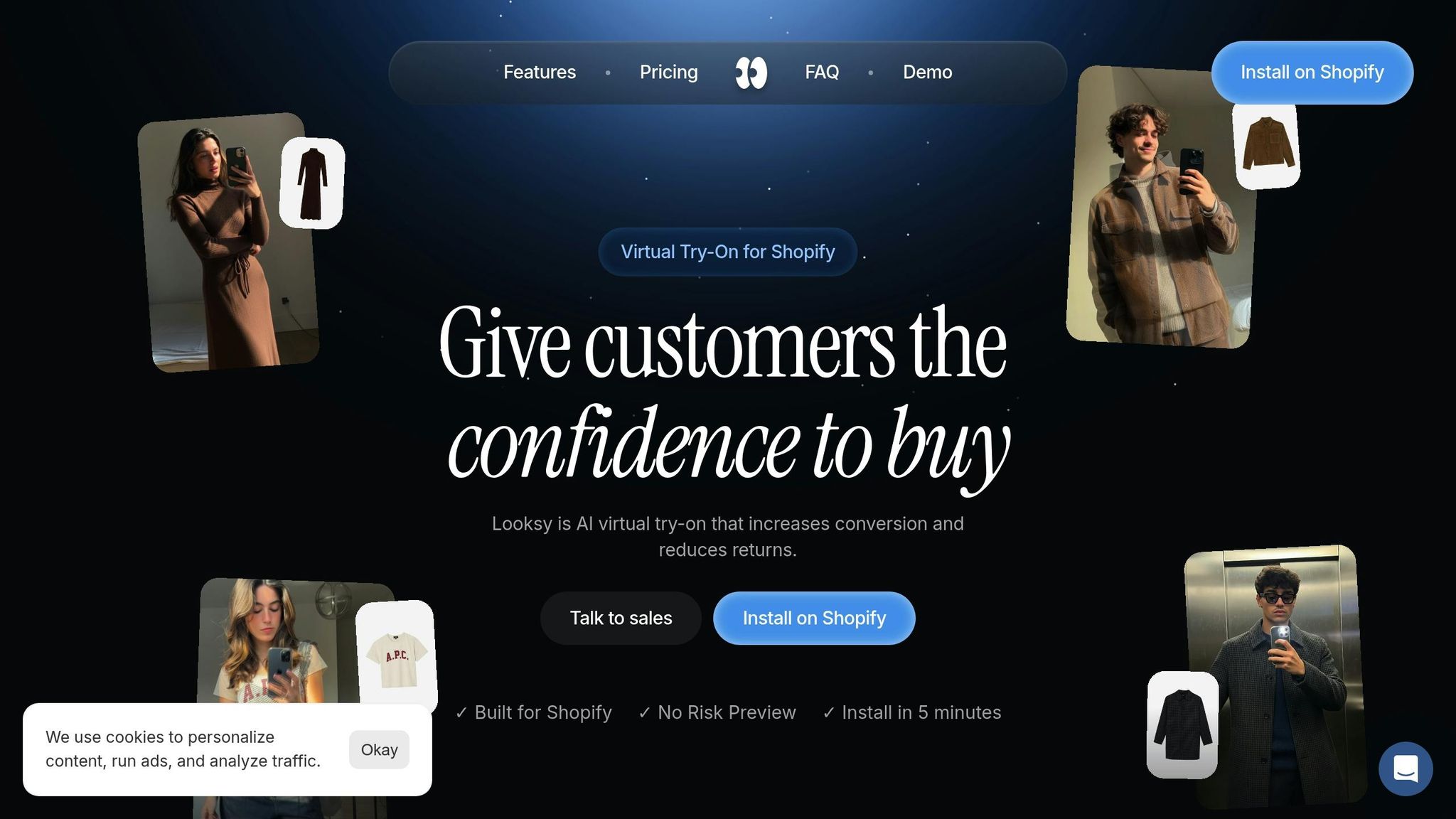
Every virtual try-on session is a treasure trove of insights into shopper behavior. Looksy Analytics tracks these interactions, including try-on activity and dwell time, to pinpoint high-interest products - those items shoppers are seriously considering, even if they haven’t added them to their carts yet. This data allows you to measure the revenue impact of interactive features and refine your approach. For example, you can use Looksy Analytics to segment shoppers and follow up with personalized email or SMS messages, turning interest into actual sales. Over time, this feedback loop not only improves your merchandising strategy but also strengthens customer trust and loyalty.
Conclusion: Your 2026 Conversion Growth Plan
To thrive in 2026, fashion retailers need to blend advanced technology with a deep understanding of customer behavior. By following a structured, data-driven strategy, you can elevate your conversion rates and stay ahead of the competition.
Step-by-Step Approach to Increase Conversions
Start by using Shopify Analytics to establish baseline metrics and identify areas where customers drop off. Once you’ve pinpointed these pain points, focus on optimizing your mobile experience. Aim for an Interaction to Next Paint (INP) of 200 milliseconds or less to ensure fast and seamless browsing.
Introduce virtual try-on tools on key product pages. Here’s a simple 30-day rollout plan:
Week 1: Define your KPIs and audit your product data.
Week 2: Standardize your assets and create a staging theme.
Week 3: Implement the tool on 3–5 high-impact product pages.
Week 4: Soft launch to your most engaged customers.
Start with categories that often cause fit-related concerns, like outerwear, footwear, or eyewear, before expanding to your entire catalog.
Pair these efforts with AI-powered tools for personalized recommendations and dynamic sizing. Use these features across collection pages, product pages, and the shopping cart. Simplify the checkout process with options like Shop Pay, which can boost conversions by up to 50%. This strategy complements earlier personalization efforts, creating a consistent and customer-focused shopping experience.
Key Metrics to Track Over Time
Keep a close eye on the numbers that matter most for your business:
Conversion rate by device and traffic source.
Return rate, particularly those tied to fit and sizing issues. Aim to stay below the 19.3% industry average.
Average order value (AOV) to measure how much customers are spending per transaction.
Track technical performance by monitoring your INP score, and analyze funnel drop-offs between “checkout reached” and “order completed” to identify friction points. To get a full picture of your customer journey, measure both macro conversions (like purchases) and micro conversions (such as email sign-ups and add-to-cart actions).
Final Takeaways for Shopify Fashion Stores
In 2026, a mobile-first, customer-focused approach is non-negotiable. With nearly 80% of retail website visits and 66% of online orders coming from mobile devices, every optimization should prioritize the mobile experience. Tools like Looksy Analytics can help you understand which products are driving engagement - even before they’re added to the cart - and enable you to follow up with personalized outreach.
Run A/B tests over a full business cycle to achieve 95% statistical significance. And remember, conversion optimization isn’t a one-time fix - it’s an ongoing process. The retailers that consistently refine their strategies based on real customer data will be the ones leading the market in 2026 and beyond.
FAQs
How do AI-powered virtual try-on tools help reduce return rates for fashion eCommerce stores?
AI-powered virtual try-on tools let shoppers visualize how clothes will fit and look on their bodies by using advanced augmented reality (AR) and AI-based body measurement technology. These tools tackle common worries about size and fit, helping customers feel more confident in their purchases and lowering the chances of returns due to sizing problems.
Beyond enhancing the shopping experience, this technology also helps retailers cut down on the expenses and logistical headaches tied to high return rates. For fashion businesses, it’s a smart way to improve customer satisfaction while increasing profitability.
What are the best mobile optimization strategies to boost conversion rates for fashion stores?
To improve mobile conversion rates, focus on creating a fast and responsive design that works effortlessly on smaller screens. Speed is crucial - compress images, enable browser caching, and opt for lightweight themes to ensure quick load times. A fully responsive layout is equally important, allowing product images and text to adjust seamlessly across different devices. Simplify navigation with clear menus, large, tap-friendly buttons, and prominent calls-to-action (CTAs) placed above the fold. Streamline the checkout process by reducing form fields and offering one-tap payment options like Apple Pay or Google Pay for a hassle-free experience.
Another critical factor is personalization. Shoppers now expect tailored experiences, such as product recommendations based on their size, AI-driven style suggestions, and real-time inventory updates. By combining speed, ease of use, and personalized features, you can create a smooth, engaging shopping experience that turns more mobile visitors into loyal customers.
How does personalization help improve conversion rates in fashion eCommerce?
Personalization has transformed the fashion eCommerce landscape, offering a way to significantly increase conversion rates through tailored shopping experiences. With the help of AI-driven tools, businesses can fine-tune product recommendations, messaging, and on-site content to align with each shopper’s unique preferences. This approach can turn casual browsers into repeat customers.
When shoppers feel understood, they’re more inclined to make a purchase. Research highlights that many consumers become frustrated when brands fail to deliver personalized experiences, often resulting in lost sales and weakened loyalty. On the other hand, offering tailored interactions - such as custom product suggestions or dynamic pricing - can lead to higher sales, improved customer satisfaction, and stronger retention. In today’s competitive market, personalization has moved from being a nice-to-have to an absolute must for success.