Ecommerce
7 Ways Virtual Try-On Reduces Return Rates
How virtual try-on cuts size and style mismatches, reduces multi-size orders and return costs, and raises conversions for ecommerce stores.
Virtual try-on technology is helping online stores cut return rates by addressing common shopping issues like size, fit, and style mismatches. By using augmented reality (AR) and artificial intelligence (AI), customers can see how products look on them before buying, reducing uncertainty and boosting confidence. Here’s how virtual try-on makes a difference:
Cuts Size-Related Returns: Eliminates guesswork by showing accurate fits, reducing size-related returns by up to 47%.
Aligns Style Expectations: Helps shoppers see how items will look on their body, decreasing style-related returns by up to 64%.
Boosts Buyer Confidence: Shoppers are 65% more likely to purchase when they can preview products virtually.
Reduces Multi-Size Orders: Prevents “bracketing” (ordering multiple sizes) by offering precise fit previews.
Provides Data Insights: Analyzes return patterns to improve product descriptions and sizing.
Lowers Costs: Saves $10–$20 per return while reducing waste and shipping emissions.
Increases Sales Without More Returns: Conversion rates rise by up to 90% with virtual try-on tools.
For Shopify store owners, tools like Looksy make it easy to integrate virtual try-on features, with a free plan and paid plans starting at $14.99/month. This solution not only reduces returns but also boosts sales and customer satisfaction while cutting costs.
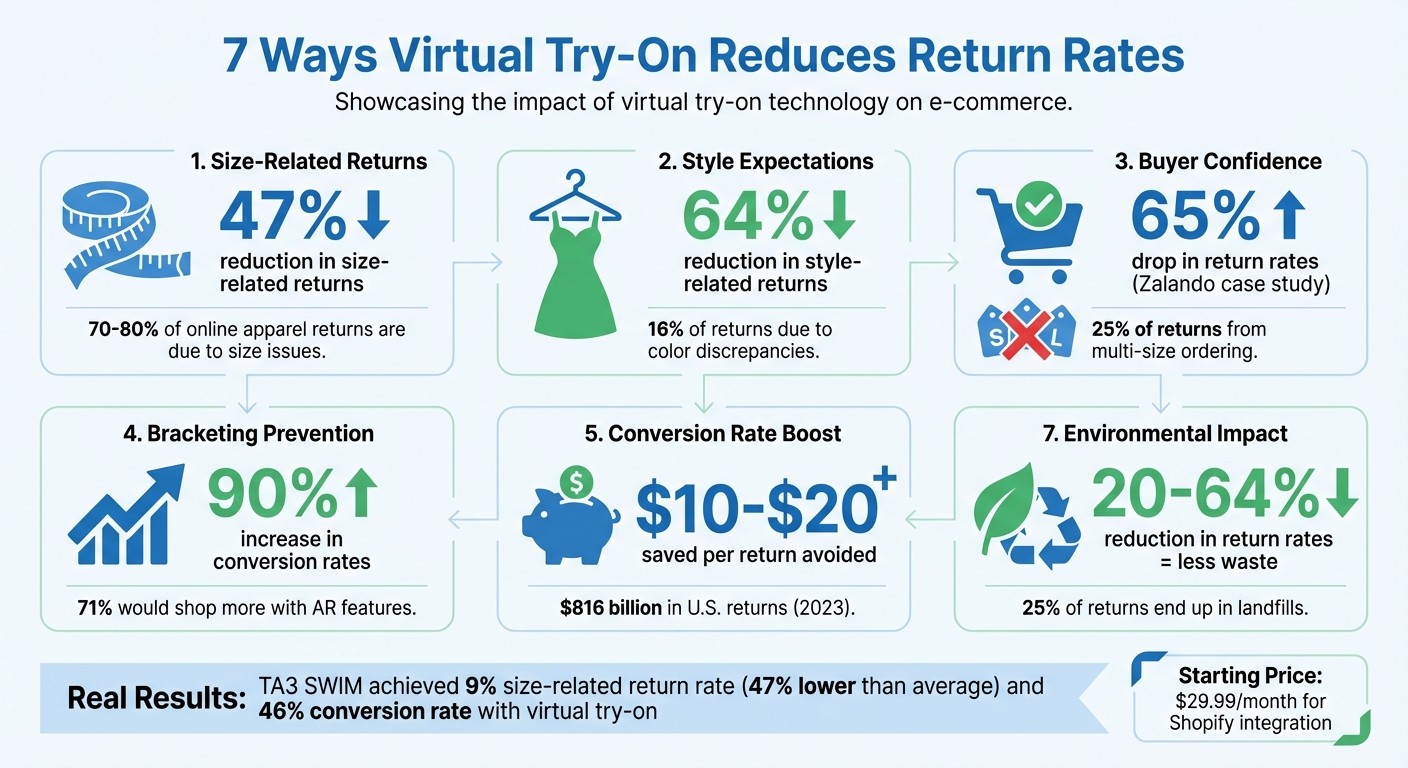
How Virtual Try-On Technology Reduces Return Rates: Key Statistics
1. Improves Size and Fit Accuracy
Did you know that size issues are behind a staggering 70%–80% of online apparel returns? Each return can cost you anywhere from $10 to $20 per item. If a shopper orders a medium or a pair of jeans that doesn’t fit, chances are it’s coming back - and that’s a major hit to your bottom line.
Virtual try-on technology is changing the game by letting customers see how clothes will fit their actual body before they buy. Instead of relying on vague size charts, shoppers can upload a photo and preview the garment on themselves. The AI behind this technology evaluates body proportions, fabric behavior, and brand-specific sizing to deliver a highly accurate fit. This eliminates the guesswork that often leads to returns and directly reduces those costly mistakes.
The results speak for themselves. Under Armour saw a 27% year-over-year drop in size-related returns after adopting virtual fitting technology in 2025. And over at Asics, customers who used virtual try-on were 10.5 times more likely to complete a purchase than those who didn’t. These aren’t minor tweaks - they’re transformative shifts that boost both customer satisfaction and profitability.
For Shopify store owners, tools like Looksy make it easy to bring this technology to your storefront. Looksy integrates directly with your size charts and product data. Shoppers just click “Try It On”, upload a photo, and instantly see how the item fits - no app downloads or complicated steps required. It’s a smooth, hassle-free experience that builds trust and encourages confident purchases.
“In online shopping, confidence is everything - especially when it comes to choosing the right size. If the experience feels clunky, long, or confusing, shoppers can lose trust fast.” - Emory Takagi, Head of Design, Virtusize
2. Matches Style Expectations with Reality
When what you see online doesn’t match what you get in person, it can hurt sales - and lead to a lot of returns. For instance, a dress that looks flawless on a professional model might not translate the same way on a customer’s body. This mismatch is a big deal, with color discrepancies alone driving 16% of returns and contributing to a 24.4% overall return rate.
Enter virtual try-on technology, which bridges this gap by allowing shoppers to see how clothing looks on their own bodies instead of a standard model. It gives a realistic preview of how a garment fits, drapes, or complements their skin tone. Instead of guessing, customers get a clear picture of what to expect before they hit “buy.”
Retailers using virtual try-on tools have seen impressive results, with return rates dropping by 20–30% on average. Some have even reported reductions as high as 64%. Plus, 78% of users say they feel more confident in their purchases, which significantly cuts down on style-related returns. These numbers highlight how this technology can reshape the shopping experience.
Walmart has embraced this shift with its enhanced virtual try-on feature, introduced after acquiring Zeekit. It allows customers to visualize over 270,000 clothing items on photos of themselves. This kind of functionality ensures that what customers see aligns with what they get, reducing the risk of disappointment.
For Shopify stores, Looksy offers a seamless way to bring this advanced technology to life. Customers can upload a photo and instantly view products from multiple angles, seeing how colors and styles suit their unique appearance. There’s no need for app downloads or extra steps - just quick, easy visual confirmation that builds confidence and reduces returns tied to style mismatches.
3. Increases Customer Confidence Before Purchase
Virtual try-on does more than just match style with reality - it builds trust. Without the ability to try before they buy, shoppers often hesitate, second-guessing their choices. This uncertainty frequently leads to abandoned carts or an influx of returns. Virtual try-on changes the game by offering a clear, accurate preview of items, helping shoppers feel more confident in their decisions.
This confidence boost is powerful. Shoppers using virtual try-on are 65% more likely to place an order. It turns indecision into action, making purchases feel less risky. For U.S. Shopify stores, where online apparel returns hit an estimated $38 billion in 2023, this is a big deal. Size and fit issues alone accounted for 53% of those returns. By giving customers visual confirmation upfront, virtual try-on reduces doubt and ensures they’re more certain before clicking “buy.”
Looksy makes this process even easier. It integrates directly with Shopify, allowing customers to upload a photo and see products from multiple angles - all without needing additional downloads. When shoppers feel confident in their choices, they’re less likely to return items. This not only lowers costs but also simplifies the shopping experience, creating a smoother path to smarter customer engagement across your store.
4. Stops Customers from Ordering Multiple Sizes
Virtual try-on technology doesn’t just boost buyer confidence - it also tackles the issue of customers ordering multiple sizes of the same item.
This practice, often called “bracketing”, is a common safety net for hesitant online shoppers. They purchase two or three sizes of the same product, planning to keep the one that fits and return the rest. While it might ease customer concerns, it significantly increases costs for retailers. Virtual try-on changes the game by showing shoppers how a specific size will look and fit on their body before they make a purchase.
When customers can preview the fit and drape of an item in a realistic way, the need for backup sizes disappears. For example, in April 2023, Zalando tested its in-house virtual try-on tool, which created 3D body shapes from user photos. The results? A 40% drop in return rates, proving how visual accuracy can reshape shopping habits.
This issue is particularly pressing for U.S. Shopify stores. In 2022, retail returns in the United States reached a staggering $817 billion, with online shopping responsible for a quarter of that total. When customers order multiple sizes, the costs of processing and shipping those returns add up quickly. Virtual try-on removes the guesswork, allowing stores to protect their margins while offering a smoother shopping experience.
For Shopify merchants, Looksy provides a seamless solution. Customers simply upload a photo to get an instant and accurate preview of how an item will fit - no more need for backup sizes. By solving fit issues upfront, Looksy helps retailers cut down on unnecessary orders and the expensive reverse logistics tied to returns. This not only protects profits but also streamlines operations for long-term success.
5. Provides Analytics to Identify Return Patterns
Virtual try-on technology doesn’t just help reduce returns - it digs deeper to uncover why returns happen in the first place. Every time a customer uses the virtual try-on feature, valuable data is generated. This data sheds light on the root causes of returns, giving businesses the tools to make smarter, more informed decisions about their product offerings.
For instance, analytics can reveal which specific product variations - like color, size, or style - are returned most often. This SKU-level insight helps merchants address recurring issues by refining size guides, enhancing product descriptions, or adjusting inventory. Imagine discovering that a medium-sized dress is frequently returned due to fit complaints. With this information, you can update the product page with more precise measurements or even tweak the size guide to better match customer expectations.
Another common issue analytics can tackle is bracketing - when customers order the same item in multiple sizes to ensure they get the right fit. By identifying this pattern early, U.S. Shopify stores can create strategies to minimize this costly practice, such as offering more detailed sizing tools or tailored recommendations.
This data becomes especially crucial for U.S. retailers, where processing a return can cost up to 66% of the product’s price. Tools like Looksy’s platform provide detailed insights into try-on interactions, conversion rates, and product-specific trends. Armed with this information, store owners can take actionable steps - whether it’s updating product imagery, fine-tuning size recommendations, or optimizing inventory based on customer-specific body measurements instead of generic size charts. These analytics not only enhance the virtual try-on experience but also help streamline operations and protect profit margins.
6. Reduces Return Costs and Environmental Impact
Every return that lands back at your warehouse brings more than just the cost of the product - there’s a cascade of expenses involved. On average, processing a single return costs between $10 and $20, sometimes climbing to a staggering 66% of the product’s original price. In 2023 alone, U.S. merchandise returns resulted in $816 billion in lost value, with $25.1 billion of that attributed to processing costs for apparel and footwear. These figures highlight how crucial it is to find smarter, more sustainable ways to manage returns.
Virtual try-on technology provides a game-changing solution, cutting return rates by an impressive 20% to 64%. With fewer returns, businesses save on shipping, inspection, and restocking costs, leading to meaningful financial relief.
The environmental impact is just as striking. About 25% of returned items end up in landfills, while transportation linked to returns generates millions of tons of CO₂ emissions. Virtual try-on helps tackle these issues at the source - when customers get the right fit from the start, the need for multiple shipping cycles disappears. This reduces packaging waste, slashes transport emissions, and keeps more products in circulation instead of heading to the dump.
“Reducing returns saves money and cuts environmental impact. Every avoided shipment means less packaging waste and lower transport emissions, making virtual try-on an important step toward sustainable commerce.” - Shopify
Looksy’s platform is at the forefront of this shift, combining financial savings with eco-conscious practices. By offering accurate fit visualization, Looksy’s virtual try-on technology prevents unnecessary returns, delivering both cost savings and environmental benefits. With 67% of apparel brands believing that eliminating returns could boost their profits by at least 20%, adopting virtual try-on isn’t just a smart business move - it’s a step toward a more sustainable future.
7. Drives Sales Without Increasing Returns
For online retailers, the goal isn’t just to boost sales - it’s to ensure those sales are meaningful and profitable. Virtual try-on technology achieves this by increasing conversion rates while keeping return rates in check, ultimately safeguarding profit margins.
Retailers using virtual try-on tools have reported impressive results. For example, conversion rates can climb by as much as 90% among shoppers who actively engage with these features. Rebecca Minkoff found that customers were 65% more likely to make a purchase after interacting with 3D and AR visualization tools. These aren’t impulse buyers; they’re shoppers with high intent, already confident in the product’s appearance and fit. This streamlined decision-making process not only drives more purchases but also helps reduce unnecessary returns.
One of the standout benefits of virtual try-on technology is its ability to encourage confident, single-item purchases. By giving shoppers a clear, data-backed view of how a product looks on them, it minimizes the need for “just-in-case” orders. Fewer redundant purchases mean fewer returns, even as sales continue to grow.
If you’re looking to integrate this technology into your store, Looksy offers affordable options. The Free plan includes unlimited try-ons, and paid plans run from $14.99/month for 100 photo try-on credits to $29/month for 300 credits and $79/month for 600 photo or video credits with realtime video try-on. Every plan provides engagement data, so you can track which try-on sessions lead to actual sales.
The numbers speak for themselves: 71% of online shoppers say they’d shop more frequently if AR features were available, and 78% of virtual try-on users report feeling more confident in their buying decisions. Virtual try-on technology not only drives sales but also helps maintain a low return rate, making it a win-win for retailers and customers alike.
Comparison Table
Virtual try-on technology is transforming the online shopping experience. Below is a comparison of key metrics, along with a real-world example that highlights the impact of integrating virtual try-on solutions for Shopify stores.
Metric | Traditional eCommerce | With Virtual Try-On | Improvement |
|---|---|---|---|
Size-Related Return Rate | 38% of all apparel returns | 9% | 47% lower than website average |
Bracketing-Related Returns | About 25% of returns | 2% | Sharp drop in multi-size ordering |
Conversion Rate | Standard eCommerce rates | 46% | Significant boost in purchase intent |
Customer Trust in Recommendations | Low (static size charts) | 80% | 80% of users trust and buy the suggested size |
Data Source:,
Now, let’s look at a case study that brings these numbers to life, showcasing how virtual try-ons can reduce return rates and build customer confidence.
Real-World Case Study: TA3 SWIM
In October 2022, TA3 SWIM, a U.S.-based swimwear brand known for its sculpting compression fabrics, was struggling with high return rates caused by sizing confusion. After adopting AI-driven virtual try-on technology and monitoring the results over six months, the brand achieved remarkable improvements:
Size-related return rates dropped to just 9% - 47% lower than their site’s average and 76% below the market average.
Bracketing-related returns fell to only 2%.
46% of customers who used the virtual try-on tool went on to make a purchase.
“Size-related and bracketing-related returns were our biggest struggle. However, implementing our virtual try-on solution has worked wonders on TA3 SWIM’s return rate.”
Leila Shams, Founder and CEO, TA3 SWIM
These results highlight why Looksy has become the go-to virtual try-on solution for Shopify merchants. The Free plan includes unlimited try-ons, and paid plans run from $14.99 per month for 100 photo try-on credits to $29 per month for 300 credits and $79 per month for 600 photo or video credits. Every paid plan removes Looksy branding and unlocks unlimited size, bundles, and email capture, while the Scale plan adds realtime video try-on.
Conclusion
Virtual try-on technology offers a practical solution to the costly issue of size and fit returns. The strategies discussed in this article work together to tackle bracketing, enhance customer confidence, and provide valuable insights to refine product offerings. When shoppers can visualize how clothing will look and fit on their bodies, they make more informed decisions. This not only reduces returns but also increases profits, creating a win-win for businesses and their customers.
The numbers speak for themselves: virtual try-on can cut return rates by up to 64% while boosting conversion rates by 15–40%. For U.S. Shopify store owners, who face annual returns totaling $816 billion in merchandise, even small reductions in return rates can result in significant savings. With return processing costs ranging from $10 to $20 per item, the potential financial impact is enormous.
But the benefits go beyond immediate cost savings. Virtual try-on tools foster long-term customer loyalty. Shoppers using these tools report a 78% increase in confidence when making purchases, which translates into better Net Promoter Scores and more repeat business. Additionally, these tools align with sustainability goals by cutting down on the carbon emissions and packaging waste associated with returns. This eco-friendly edge not only strengthens brand reputation but also delivers measurable returns on investment.
Looksy’s integration for Shopify stores makes adopting this technology accessible and affordable. With a free plan that includes unlimited try-ons and paid plans starting at $14.99 per month for 100 photo try-on credits, Looksy provides a cost-effective way to test the technology before scaling it across the catalog. With the virtual fitting room market expected to grow from $6.86 billion in 2025 to $24.30 billion by 2032, early adopters are already reaping the rewards.
Virtual try-on technology is no longer just an option - it’s a must-have for reducing returns, improving customer satisfaction, and staying competitive in today’s market.
FAQs
How does virtual try-on technology boost customer confidence when shopping online?
Virtual try-on technology is changing the way people shop by letting them see exactly how a product will look on them before they buy. With the help of a photo or a body scan, this tech creates a 3D avatar that shows how clothing, shoes, or accessories will fit, drape, and look in real life. It takes the guesswork out of online shopping and makes size charts feel more tailored and reliable.
On top of that, many virtual try-on tools include AI-powered size recommendations and style tips, which make shopping even easier. This mix of visual precision and personalized advice helps shoppers feel more confident about their choices. It also cuts down on unnecessary purchases and returns, making the whole process smoother for everyone.
How does virtual try-on technology benefit the environment?
Virtual try-on technology offers a practical way to reduce environmental impact by cutting down on product returns. When shoppers can see how clothing, shoes, or accessories will look on them before buying, they’re less likely to make returns. This means fewer items being shipped back and forth, which translates into lower fuel use and less packaging waste.
The benefits go beyond just shipping. Fewer returns mean less waste ending up in landfills, reduced greenhouse gas emissions, and decreased demand for new inventory. This, in turn, lowers the need for resource extraction and manufacturing. By incorporating virtual try-on tools, e-commerce retailers can shrink their carbon footprint and encourage more eco-friendly shopping habits.
How can I add virtual try-on technology to my Shopify store?
Adding virtual try-on functionality to your Shopify store is straightforward and can be done in just a few steps. Start by exploring the Shopify App Store to find a virtual try-on app that aligns with your product category - whether it’s clothing, eyewear, or accessories - and includes AI or AR capabilities. Once you’ve chosen the right app, install it directly from the store and follow the setup instructions to upload product images or 3D models. Most apps come with a built-in “Try-On” button that integrates easily into your product pages, no coding required.
After installation, customize the settings to fit your store’s branding. You can adjust options like size recommendations, camera access permissions, and the overall design of the try-on interface. Be sure to test the feature on both desktop and mobile devices to ensure everything runs smoothly and loads quickly. To make the most of this feature, highlight it on your site with clear calls-to-action, like “Try It On Now”, to encourage shoppers to engage. Virtual try-on can boost customer confidence, minimize returns, and enhance the shopping experience.