Ecommerce
Complete Guide to AI Tools for Shopify Stores
Overview of AI tools for Shopify: virtual try-ons, personalized recommendations, inventory forecasting, chatbots, dynamic pricing, and ROI measurement.

AI is reshaping Shopify stores in 2026. From boosting sales to improving operations, these tools are no longer optional - they’re essential for staying ahead. Here’s what you need to know:
84% of ecommerce businesses see measurable benefits from AI, including higher efficiency and revenue growth.
AI is driving $240–$390 billion annually in retail value, with tools like virtual try-ons and chatbots increasing conversion rates by up to 15%.
Key uses include:
Personalized recommendations to increase order value and reduce returns.
Virtual try-ons for fashion stores, cutting return rates by up to 45%.
Automated operations like inventory forecasting and dynamic pricing.
AI-powered customer support, handling 70% of routine queries.
Popular tools like Shopify Magic, Looksy, and Shopify Inbox integrate seamlessly, saving time and cutting costs.
Bottom line: AI tools simplify operations, improve customer experience, and drive growth. Start small with free tools and expand based on measurable results.
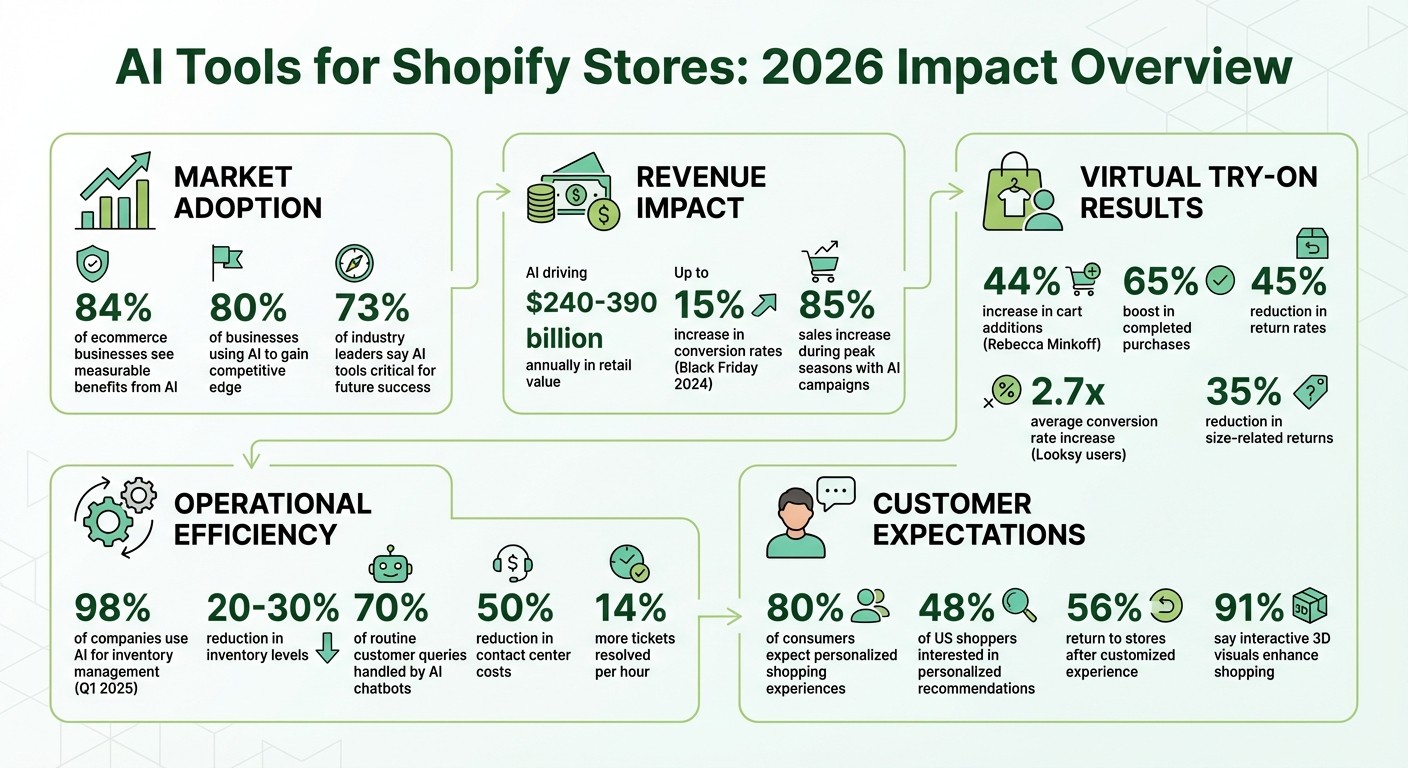
AI Tools Impact on Shopify Stores: Key Statistics and Benefits in 2026
AI Virtual Try-On for Shopify
Virtual try-on technology blends augmented reality (AR) for visual overlays, artificial intelligence (AI) for body measurement and fit prediction, and 3D modeling to replicate fabric draping and movement. For Shopify fashion and accessory stores, this means customers can see how a product looks on them before making a purchase - all without downloading an app, right from the comfort of their home.
The results speak for themselves. Rebecca Minkoff added 3D and AR viewing to their online store, leading to a 44% increase in cart additions and a 65% boost in completed purchases. Gunner Kennels used 3D assets to help customers visualize the size of dog crates, which resulted in a 40% jump in conversion rates. Similarly, Amazon reports that shoppers who use AR Virtual Try-On features are twice as likely to make a purchase.
How AI Virtual Try-On Works
The process is simple: a shopper uploads a photo or uses their device camera. The AI then identifies key landmarks, adjusts for lighting, and renders the product in just three seconds. Tools like Looksy integrate seamlessly with Shopify themes through the Storefront API, utilizing Shopify’s AR framework to deliver a smooth experience on both iOS and Android devices.
To ensure optimal performance on mobile - where most retail orders happen - 3D assets need to be optimized to under 5MB or 50,000 polygons. The technology uses Physically Based Rendering (PBR) to create realistic textures, making garments look as lifelike as they would in person.
Benefits for Fashion and Apparel Stores
Virtual try-on tools help eliminate the uncertainty that often comes with online shopping. The National Retail Federation estimates online return rates could exceed 19% by 2025. One fashion brand reduced return rates by 45% after implementing AI-powered sizing and preview features.
Looksy does not publish conversion or returns benchmarks, so the effect is something to measure on your own store. Shoppers can make purchase decisions in as little as 15 seconds. Additionally, 91% of users say interactive 3D visuals enhance their shopping experience, and 52% feel these tools help them better understand how a product will look, fit, or function.
These tools also promote inclusivity by allowing users to select avatars that reflect diverse body types, ages, and skin tones. This not only improves brand perception but also builds customer loyalty. On top of that, virtual try-on technology can contribute to sustainability by reducing packaging waste and transportation emissions tied to product returns. It’s a win-win for both shoppers and businesses, streamlining the online shopping experience while setting the stage for growth.
Setting Up Looksy on Your Shopify Store
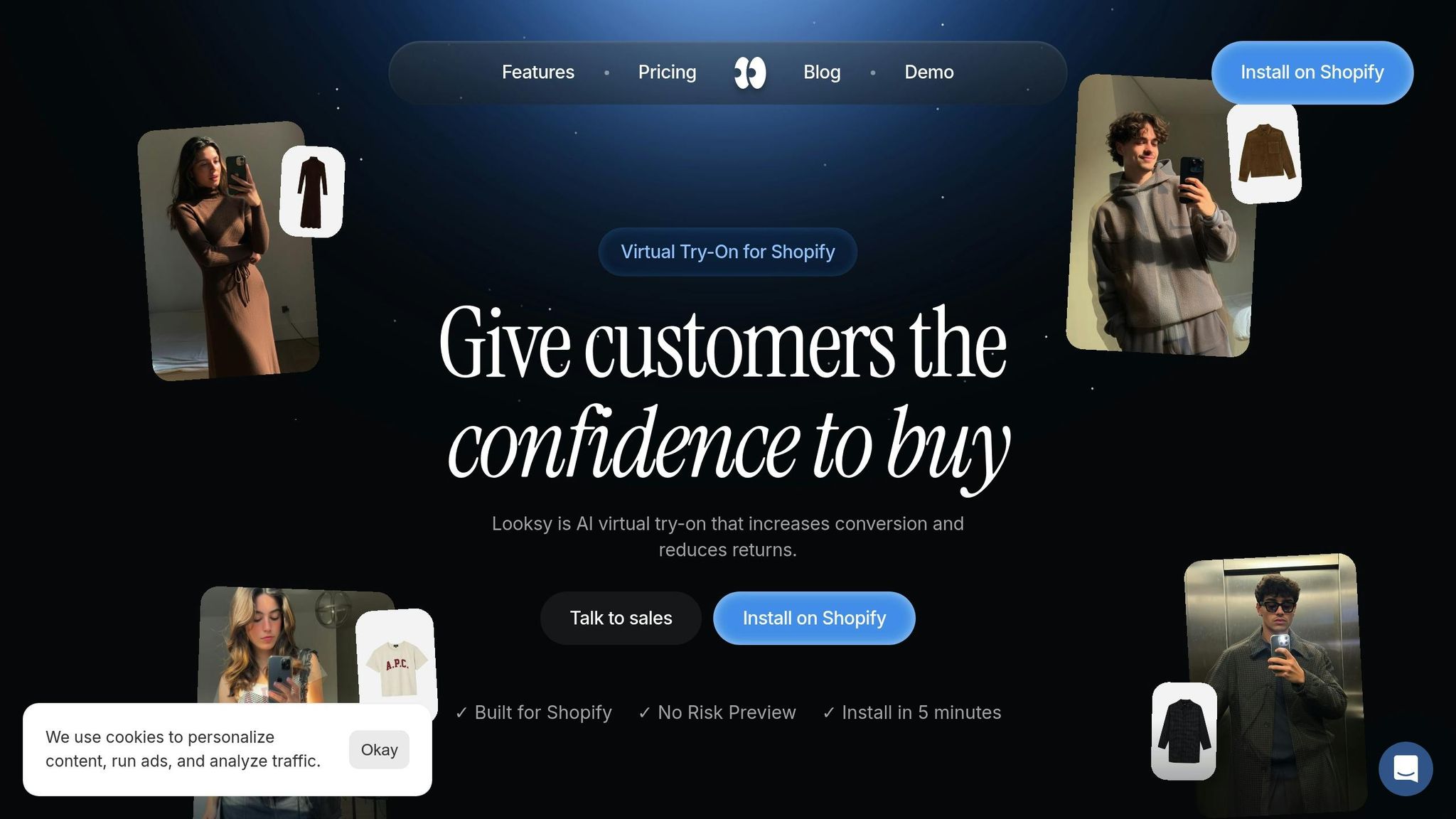
Given these advantages, adding Looksy to your Shopify store is a logical next step. Installation is quick and easy - Looksy can be added directly from the Shopify App Store in just five minutes. The tool automatically integrates with your store’s existing design, matching fonts, colors, and buttons to maintain brand consistency. It functions as a lightweight store extension, loading asynchronously to preserve site speed and SEO performance.
Once installed, you can decide which products will feature the virtual try-on option. The AI handles garment mapping automatically. The “Try On” button can be prominently placed above the fold on product pages to maximize visibility. Looksy prioritizes privacy, with customer photos processed instantly via API and never stored on servers.
To get started, try Looksy’s Free plan to see how the AI renders your products before committing to a paid plan. Pricing begins at $14.99 per month for the Starter plan, which includes 100 photo try-on credits ($0.14 per additional credit). Higher-tier plans, Growth and Scale, offer larger credit volumes, Looksy branding removal, and realtime video try-on on Scale. Use the Looksy dashboard to track try-on sessions, monitor conversions, and measure your return on investment.
AI for Product Discovery and Recommendations
AI simplifies product discovery by identifying exactly what customers are looking for. Recommendation engines powered by AI rely on three main techniques: content-based filtering (matching product attributes like color or material), collaborative filtering (analyzing the habits of similar shoppers), and hybrid filtering (combining both methods for better precision). In 2023, nearly 48% of US shoppers expressed interest in personalized product recommendations, and 56% said they returned to a store after enjoying a customized shopping experience. These methods form the backbone of tailored recommendations that elevate the shopping experience.
Personalized Product Recommendations
Personalized suggestions can appear at various stages of a shopper’s journey - whether it’s through adaptive homepage carousels, “Pairs well with…” sections on product pages, or bundled checkout prompts. Take Gymshark, for example. Their checkout page features a “People also bought” carousel, powered by an AI recommendation engine that analyzes customer behavior to suggest relevant items.
Shopify Magic offers free AI tools for text and media generation, available to all users regardless of subscription type. To measure the success of these recommendations, tracking Revenue Per Visitor (RPV) is key. A steady rise in RPV indicates that the AI is effectively connecting shoppers with products they’re likely to buy. Beyond personalized suggestions, advanced search and visual tools further enhance product discovery, making shopping more intuitive.
AI-Powered Search Features
Natural language processing (NLP) has revolutionized product searches in extensive catalogs. Instead of relying on exact keyword matches, AI understands the intent behind queries like “red dress for summer wedding” and delivers the most relevant results. Features like typo tolerance automatically correct errors - turning “sneekers” into “sneakers” - to avoid frustrating “no results found” pages. Meanwhile, dynamic re-ranking adjusts search results based on individual preferences, such as size, price range, or color, boosting search-to-cart conversions.
Autocomplete powered by AI also plays a role, suggesting products as users type, which reduces friction and guides them to items they’re more likely to buy. For stores with extensive inventories, AI-driven analytics can identify search terms that lead to zero results. This insight helps create synonym groups to bridge the gap between how customers describe products and how they’re listed in the catalog.
Visual Search and Similar Product Suggestions
Visual search takes shopping convenience to the next level. Customers can upload photos - often screenshots from platforms like Instagram or TikTok - and instantly find similar items in your inventory. Using computer vision, the system evaluates attributes like color, shape, and texture to deliver accurate matches. Features like “Shop the Look” go even further, presenting full outfits or complementary products to encourage multi-item purchases.
This technology mimics natural shopping habits, cutting down on the need for manual searches. Tools such as ViSenze make visual search accessible, offering free installation for up to 100,000 API requests, with paid plans starting at $480/month for the “Adopt” tier. The impact of such tools is clear: during Black Friday 2024, online retailers leveraging AI chatbots and visual discovery tools saw a 15% boost in conversion rates. As the ecommerce AI market is projected to grow from $9.2 billion in 2025 to $16.3 billion by 2029, these tools are becoming essential for staying competitive in the online retail space.
AI Automation for Store Operations
AI has transformed store operations by automating tasks that used to take hours. By Q1 2025, 98% of companies had adopted AI for inventory management and forecasting. This shift from manual spreadsheets to machine-learning algorithms allows merchants to focus on growing their businesses instead of getting bogged down in data entry. These tools now handle everything from stock monitoring to customer inquiries, creating smoother operations with minimal manual oversight. This efficiency opens the door for more advanced applications in areas like demand forecasting, pricing strategies, and customer engagement.
Inventory and Demand Forecasting
AI has revolutionized inventory and demand forecasting, analyzing everything from seasonal trends to promotional events. Machine learning combines external data - like weather APIs, social sentiment, and competitor pricing - with internal sales data to deliver precise SKU-level predictions. This approach can reduce inventory levels by 20% to 30% without sacrificing service quality.
For example, in 2025, online jewelry brand Kimai used Prediko to connect three Shopify stores with historical sales data. The result? Delivery times dropped by 43%, and production costs were cut by 11%. Similarly, footwear brand CloudSharks partnered with Prediko to move beyond basic volume-based ordering. By incorporating 12 months of expected sales data, they reduced stockouts by 35%. Shopify brand Healf also embraced predictive planning through Prediko, achieving a staggering 75x return on their inventory management investment.
“Usual stock management involves human involvement, but by setting up Flow, we’re able to save a huge amount of time and eliminate human error.”
– Panos Voulgaris, Creative Strategy Director, Cozykids
Shopify Flow simplifies workflows by automating tasks like tagging low-stock items, emailing suppliers, or triggering purchase orders when inventory runs low. Advanced tools like real-time tracking, powered by computer vision and robotics, minimize errors that come with manual barcode scanning. To get started, businesses should prepare 12–18 months of clean, labeled order and web traffic data before integrating AI models. While AI excels at forecasting for products with steady demand, human input remains essential for new product launches or short-lifecycle items.
Dynamic Pricing and Promotions
AI enables dynamic pricing by analyzing site traffic, competitor prices, customer behavior, and inventory levels. Instead of applying flat discounts, these systems test gradual markdowns on slow-moving items, stopping once sales targets are hit. This approach helps protect margins while clearing inventory.
French delivery service Chronopost saw an 85% increase in sales during the 2022 holiday season thanks to AI-driven campaigns. Personalization powered by AI can also boost revenue by 5% to 15%. Tools like Prisync, which starts at $99/month, track competitor prices hourly and automatically update listings. Shopify Sidekick, available for free, allows merchants to set up discounts and launch promotions using simple natural language commands.
“Having an assistant who understands your business and helps design, execute, and tweak strategy is a massive power-up. With access to your business data and tools, it becomes a marketing expert wired into your systems - a superpower.”
– Alex Pilon, Senior Developer, Shopify
AI also personalizes the shopping experience by analyzing cart size, customer loyalty, and price sensitivity to offer tailored coupons or discounts at checkout. Regular split tests on pricing, shipping thresholds, and promotional headlines further optimize results. Predictive models help free up to 30% of working capital quickly by optimizing payables and receivables.
Beyond pricing, AI ensures smoother customer interactions, enhancing the overall shopping experience.
AI-Powered Customer Support
AI chatbots are streamlining customer support, handling over 70% of routine queries like order tracking, return policies, and product availability. Using Natural Language Processing, these bots understand customer intent - even with typos or casual language - and integrate directly with Shopify store data. Remarkably, 80% of customers report positive experiences after interacting with AI chatbots.
During Black Friday 2024, online retailers using AI chatbots saw a 15% boost in conversion rates. Generative AI assistants also help human agents, resolving 14% more tickets per hour and cutting handling time by 9%. By adopting AI voice and chat agents, businesses can lower contact center costs by nearly 50%, while effective chatbots save support teams up to 2 hours of work daily.
Shopify Inbox, a free tool for merchants, instantly answers common customer questions while providing full context of their cart and order history. For more complex issues, AI acts as a copilot for human agents, generating suggested replies and summarizing lengthy conversations to speed up resolutions. To ensure accuracy, businesses should upload their FAQ documents to the chatbot’s knowledge base during onboarding and monitor cases where the AI escalates issues to human agents. This helps identify and address any knowledge gaps.
Measuring AI Performance in Your Shopify Store
Tracking how AI performs in your Shopify store is key to understanding whether it’s delivering a solid return on investment. Before you introduce any AI tool, set a four-week baseline to establish a clear reference point for measuring its impact. Focus on three critical metrics: Marketing Efficiency Ratio (MER), contribution margin, and retention rates. These metrics directly tie AI’s impact to your store’s profitability, giving you a solid foundation for evaluating its success.
Key Metrics to Track
Start by monitoring your conversion rate. For most ecommerce stores, this hovers around 2–3%, but Shopify Plus merchants often see rates between 4–6%. Keep an eye on your average order value (AOV), which typically ranges from $90–$100 for fashion items and exceeds $200 for electronics. Another critical metric is cart abandonment, which averages a staggering 71% across the industry. If you’re using AI tools like Looksy for virtual try-ons, track how often customers use the feature and the conversion boost for products with virtual try-on enabled.
Real-world examples highlight the potential of these metrics. For instance, All4cycling, a Shopify Plus merchant specializing in cycling apparel, used AI-powered dashboards in 2025 to refine their product bundling strategy. By analyzing AOV, SKU dependencies, and checkout funnel performance, they boosted their conversion rate by 40% and saw a 35% increase in overall turnover. Similarly, Pullup & Dip, a fitness brand, tracked MER and blended customer acquisition costs via KPI dashboards, resulting in a 349% jump in conversion rates and a 235% rise in average revenue per user. These success stories show how tracking the right metrics can guide effective AI experimentation and optimization.
Testing and Optimization Strategies
A/B testing is a great way to measure the effectiveness of AI tools. Split your audience evenly - half experiences the AI-driven setup, while the other half uses the traditional setup. Focus on one primary metric per test to keep things clear and actionable. Calculate the payback period by dividing the net benefit by the monthly cost; aim to break even within 12 months.
Set up automated alerts for key metrics. For example, if your cart abandonment rate exceeds 75% for a week straight, trigger a browse-abandonment email flow. Use Shopify Flow to automate responses when inventory levels fall outside your target range or when specific products underperform. Start small by experimenting with free tools like Shopify Magic or Shopify Inbox before committing to more advanced solutions.
Using Data to Make Better Decisions
Once you’ve gathered data from testing, use it to make meaningful changes across your store. Segment AI-driven insights by product category, device type, and customer behavior to identify where improvements are needed. With 68% of retail orders coming from mobile devices, ensure all AI features are optimized for quick loading on smaller screens. For example, Jenni Kayne used analytics dashboards in 2025 to adjust their email marketing strategy. By rebalancing campaign versus flow revenue, they reduced email sends by 44% while increasing total revenue by 22% through smarter lifecycle automation.
“AI is going to reduce the cost of entry to marketing and ad campaigns… Having an AI assistant that understands your business context and helps you set up, analyze, and adjust campaigns is a massive power-up.”
– Alex Pilon, Senior Developer, Shopify
Leverage churn risk scores to identify customers at risk of leaving. Offer them personalized loyalty perks to re-engage before they churn. Review which product categories benefit the most from AI recommendations or virtual try-on tools. The real key isn’t just collecting data - it’s how quickly you act on those insights to drive improvements.
Conclusion
AI tools are transforming how Shopify stores function, making it easier to deliver personalized experiences and streamline operations. According to research, generative AI alone could bring immense yearly value to retailers. Consider this: 84% of ecommerce business owners have reported major benefits from their AI investments. Some businesses have even achieved significant cost savings and seen sales jump by 85% during peak seasons, thanks to AI.
These figures highlight a shifting competitive landscape. Nearly 80% of businesses are already using AI to gain an edge, and 73% of industry leaders agree that AI-powered tools will be critical for future success. On top of that, 80% of global consumers now expect shopping experiences tailored specifically to their preferences - a challenge that AI is uniquely equipped to tackle on a large scale.
To get started, explore accessible tools like Shopify Magic and Shopify Inbox, which require no technical skills. For fashion and apparel stores, integrating AI-driven virtual try-on solutions like Looksy can cut down on returns and boost conversion rates. These tools give shoppers the confidence to buy, reducing hesitation and improving overall satisfaction. The strategy? Start small, focus on measurable outcomes, and expand on what works.
The businesses that succeed in the coming years will be those that treat AI as a core part of their operations and customer service. Tools like Looksy have already shown what’s possible: the technology is readily available, its effectiveness is proven, and the barriers to entry are lower than ever. At this point, adopting AI isn’t just an option - it’s a necessity for staying competitive.
FAQs
How do AI virtual try-on tools help fashion stores reduce returns?
AI-powered virtual try-on tools use a mix of augmented reality (AR) and AI-driven body measurement technology to let shoppers see how clothes might fit before they buy. This technology bridges the gap between online shopping and in-person fitting rooms, offering a more accurate way to gauge fit and style.
By helping customers choose the right size and style upfront, these tools cut down on incorrect orders. For retailers, this means fewer returns, reduced costs, and happier customers who feel more confident in their purchases.
What are the advantages of using AI for inventory and demand forecasting in Shopify stores?
AI-driven tools for inventory and demand forecasting empower Shopify merchants to make smarter, data-backed decisions. By analyzing sales trends and predicting future demand, these tools help store owners ensure they have the right products available at the right time. This minimizes the risks of overstocking or running out of stock, keeping operations smooth and efficient.
With real-time updates that factor in sales, returns, and market trends, AI keeps your supply chain agile and in sync with actual performance. The result? Better inventory turnover, reduced storage costs, and happier customers thanks to more reliable order fulfillment. Plus, AI can run “what-if” scenarios - like testing the effects of pricing changes or launching new products - giving you the insights needed to make decisions that protect your bottom line.
How do AI-powered product recommendations help increase sales in Shopify stores?
AI-driven product recommendations work by examining customer behavior - things like browsing patterns, previous purchases, and how long someone lingers on a product page. With this information, smart algorithms predict what each shopper is most likely to buy next, offering suggestions tailored to their unique preferences in real time.
These recommendations don’t just show up randomly. They’re strategically placed at moments that matter most - like on the homepage, specific product pages, or even during checkout. This approach ensures shoppers see the right products at the right time, which naturally leads to more exploration, higher click-through rates, bigger order sizes, and increased repeat purchases. Shopify merchants, in particular, have seen impressive growth by using these tools, as they adapt seamlessly to changing trends and inventory to keep results optimized.