Ecommerce
Virtual Try-On: Key Features to Look For
Virtual try-on reshapes shopping with AI fit previews, Shopify integration, analytics, and privacy-first processing to reduce returns and improve conversions.

Virtual try-on technology is transforming online shopping by helping customers visualize how products like clothing, accessories, or makeup fit or look before purchasing. This reduces returns, increases conversions, and boosts customer satisfaction. For example, ASOS saw a 40% drop in return rates and a 28% rise in conversions after introducing this feature. Tools like Looksy integrate easily with platforms like Shopify, offering AI-powered visualization, size recommendations, and analytics to improve the shopping experience.
Key features to look for include:
AI-Powered Visualization: Realistic 3D modeling that simulates fabric behavior and adjusts lighting for lifelike previews.
Shopify Integration: Simple setup with automated catalog synchronization and compatibility with existing themes.
No Sign-Ups Required: Web-based access without downloads, reducing barriers for users.
Analytics: Insights into customer behavior, sizing trends, and product performance.
Privacy and Security: Compliance with regulations like GDPR and BIPA, with features like real-time photo processing and encrypted data.
This technology not only saves costs by reducing returns but also supports customer confidence and engagement. Pricing options, like Looksy’s plans starting at $14.99/month, make it accessible for businesses of all sizes. Prioritize tools with strong privacy measures, fast performance, and tailored features to meet your store’s goals.
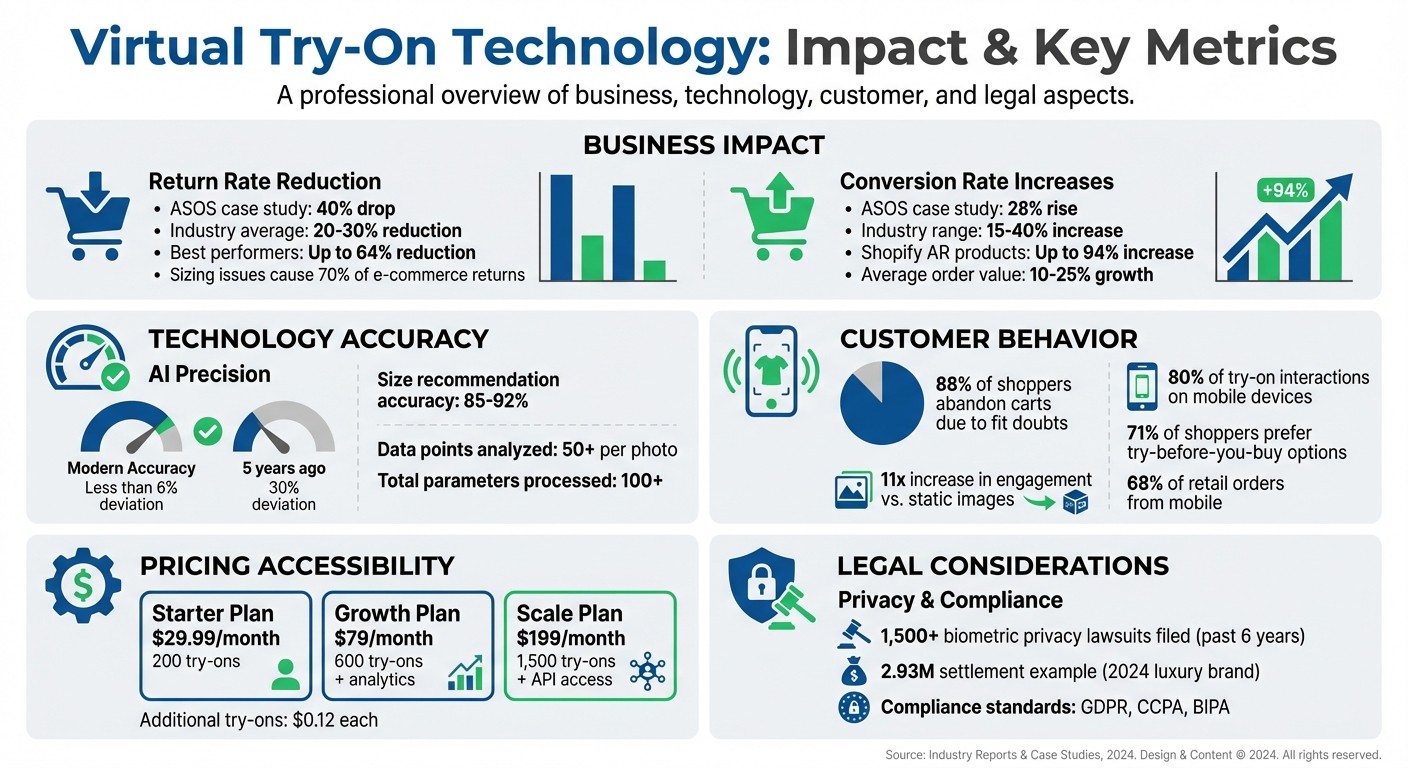
Virtual Try-On Technology Impact: Key Statistics and ROI Metrics
Core Features of Virtual Try-On Tools
AI-Powered Product Visualization
Virtual try-on tools have come a long way in creating realistic, high-quality images that mirror how items would look in real life. Using advanced AI, these tools analyze over 50 data points - like shoulder width and waist circumference - from uploaded photos to build precise 3D body models. Instead of just layering a flat image on top, they simulate how fabrics behave, offering a much more lifelike experience.
To make this even more accurate, physics engines work hand-in-hand with AI to replicate the unique characteristics of different materials. For instance, silk flows and drapes differently than denim, and this technology ensures those nuances are reflected in the virtual model. Real-time lighting adjustments further enhance the realism, adjusting shadows and highlights to match the user’s environment so garments don’t appear artificial or “cartoonish”.
Machine learning has also made significant strides in size recommendations, now achieving an impressive 85–92% accuracy rate. Dr. Sarah Chen, an AI researcher at MIT, highlights this progress:
“The accuracy of modern virtual try-on has improved dramatically. We’re now seeing less than 6% deviation from actual fit, compared to 30% just five years ago”.
Shopify Integration
For Shopify merchants, simplicity and compatibility are key. Many virtual try-on tools are designed to integrate directly with existing Shopify themes, leveraging Shopify’s Storefront API. This eliminates the need for complex coding or extensive setup, making the process quick and hassle-free. With just one click, merchants can activate the feature, and automated data synchronization ensures that the product catalog is always up-to-date, with accurate SKU matching and consistent visuals.
The payoff? Shopify data shows that products featuring augmented reality (AR) content can experience a staggering 94% increase in conversion rates. This makes virtual try-on not just a convenience but a powerful tool for driving sales.
Instant Access Without Sign-Ups
Reducing barriers for customers is critical, especially when it comes to engagement. Research reveals that 88% of shoppers abandon their carts due to doubts about size, fit, or style. Virtual try-on tools using WebAR technology address this problem by allowing users to access try-on features directly through their mobile browsers - no app downloads or sign-ups required. Since approximately 80% of virtual try-on interactions happen on mobile devices, this streamlined approach is a game-changer.
Tools like Looksy make it even easier. Customers can simply upload a photo or use their camera to receive instant visual feedback. This interactive experience doesn’t just build confidence; it can increase customer engagement by up to 11 times compared to static product images. By eliminating friction, brands can create a seamless shopping journey while gaining valuable insights for future personalization.
Analytics and Business Insights
Customer Behavior Data
Virtual try-on tools offer a treasure trove of insights into how shoppers engage with your products, shedding light on the factors that influence their buying decisions. These tools track which items, styles, and colors draw the most attention, helping you understand customer preferences at a granular level.
They also monitor key behavioral metrics like dwell time, session frequency, and interactions such as zooming or rotating 3D models, giving you a clear picture of how customers explore your products. On top of that, they analyze over 100 parameters from user photos - like body geometry, face shape, and skin tone - to provide tailored recommendations. This data maps the entire customer journey, from the initial virtual try-on to adding items to the cart.
One of the most impactful insights comes from sizing and fit data. By identifying the most commonly recommended sizes and tracking fit outcomes (e.g., “Medium fits 94% of users like you”), you can pinpoint recurring sizing issues that often lead to returns. This feedback can guide inventory management and even influence the design of future products.
These analytics don’t just refine your product strategies - they directly tie into your bottom line, making them a powerful tool for business growth.
Conversion and ROI Tracking
Virtual try-on technology has been shown to significantly boost performance metrics. Conversion rates can rise by 15–40%, with some cases seeing up to 94% increases, while average order values grow by 10–25% as customers gain confidence in their purchases.
Sizing issues are a leading cause of eCommerce returns, accounting for 70% of cases. Virtual try-on tools can reduce return rates by 20–30%, with some retailers achieving reductions as high as 64%. These improvements translate into immediate cost savings, cutting down on manual exchanges, size-related customer support requests, and logistics expenses.
Customization and Growth Options
Brand Customization
When adding a virtual try-on tool to your Shopify store, it’s important that it blends effortlessly with your brand. Many Shopify apps allow you to tweak key elements like the try-on button, interface colors, and fonts, ensuring the tool matches your store’s existing theme. You can also decide where the widget appears - whether it’s on specific product pages, across collections, or as a floating action button.
For those looking to elevate the experience, higher-tier plans often include white-label options. These remove developer watermarks, giving you full control over the branding. And this matters - a consistent brand experience builds trust, with 71% of shoppers favoring interactive, try-before-you-buy options.
Customization doesn’t stop at colors and buttons. Some tools let you create digital twins of your products using 3D modeling or photogrammetry, replicating textures, colors, and materials with precision. To keep things running smoothly, especially on mobile, ensure 3D models are under 5MB.
And beyond design, choosing a pricing plan that supports your business’s growth is just as important, as is exploring other AI tools for Shopify stores.
Pricing Plans for Different Business Sizes
Looksy offers pricing plans tailored to businesses of all sizes. The Starter plan, priced at $14.99 per month, includes 100 photo try-on credits, with additional credits at $0.14 each. The Growth plan, at $29 per month, provides 300 credits, while the Scale plan, at $79 per month, supports 600 photo or video credits and adds realtime video try-on. If you’re unsure, the free plan gives you unlimited try-ons, allowing you to test the tool before committing.
It’s also worth considering additional costs, such as setup fees, 3D model creation, and ongoing maintenance. A smart approach is to start with a pilot program featuring your best-selling or high-return items. This can help you gauge the tool’s return on investment before rolling it out across your entire store.
Privacy and Security
When customers upload photos to try on products, they’re entrusting you with highly sensitive personal data. Virtual try-on tools process biometric identifiers, such as facial geometry scans and body landmarks, which are classified as sensitive under U.S. privacy laws. Over the past six years, more than 1,500 class-action lawsuits have been filed over violations of biometric privacy laws, emphasizing the need to prioritize data protection in these tools.
For instance, in 2024, a luxury beauty brand faced a $2.93 million settlement for collecting facial geometry scans without user consent. This not only violated Illinois’ Biometric Information Privacy Act (BIPA) but also damaged customer trust. To mitigate such risks, virtual try-on tools must include strong data protection features.
No-Storage Data Policies
One of the safest strategies is opting for tools that don’t store customer photos. Instead of retaining full images on a server, how virtual try-on technology works to process photos in real-time and only keep “derived data” - mathematical models or metrics needed for the fit. This approach significantly reduces exposure in the event of a data breach.
“Poor data hygiene can erode customer trust, and increasingly, data minimization, purpose limitation, and data retention are becoming legal requirements.” - Bipasana Joshee, Associate, Perkins Coie
This method aligns with regulations like GDPR, CCPA, and BIPA by ensuring that photos are processed instantly without being stored on servers.
Additionally, tools with clear consent flows - using plain-language prompts to explain what data is collected and for how long - help foster transparency and build customer trust. Pairing these policies with secure Shopify integration adds another layer of protection.
Secure Shopify Integration
Using native Shopify integrations provides built-in security advantages. When a virtual try-on tool connects directly with Shopify’s Storefront API, it operates within Shopify’s established security framework. This includes encrypted data transmission, multi-factor authentication, and regular security audits.
Here’s why this matters: Shopify’s native AR framework ensures virtual try-on features work seamlessly across iOS and Android without requiring custom code, which could introduce security vulnerabilities. All data is transmitted through encrypted channels, safeguarding customer information at every step.
Before selecting a tool, it’s essential to audit how data flows between systems. Carefully review contracts to ensure the provider is prohibited from sharing customer data without authorization. Confirm that the tool encrypts all endpoints and employs automated deletion processes to ensure biometric data is removed promptly after use.
Security Feature | Purpose | Compliance Standard |
|---|---|---|
Data Minimization | Stores only body landmarks/metrics | GDPR, CCPA |
Retention Schedules | Deletes data after use | BIPA (Illinois) |
Encrypted Storage | Protects sensitive biometric data | eCommerce Security Standards |
Consent UX | Secures explicit user permission | CUBI (Texas), BIPA |
Strong security measures do more than protect your business from lawsuits - they establish trust, turning casual browsers into loyal buyers.
Choosing the Right Virtual Try-On Tool
Start by clarifying your primary goal - whether it’s reducing returns or increasing conversions, or driving customer engagement. Your choice of features should align with this objective. For clothing and footwear, look for tools offering AI-driven sizing and fit recommendations that consider garment dimensions and body geometry. If you’re focusing on accessories, makeup, or eyewear, prioritize augmented reality (AR) visualization that lets customers see how products look in real time. Once you’ve identified the features you need, assess the tool’s integration and performance capabilities.
Opting for a tool with native Shopify integration can save you development headaches and ensure compatibility with your store’s theme. This kind of integration not only speeds up deployment but also minimizes technical issues.
Performance is key. Tools that deliver over 20 frames per second (FPS) and load in under two seconds make a huge difference, especially since 68% of retail orders come from mobile devices. To avoid lag on cellular connections, keep 3D assets under 5MB. A fast, seamless experience builds customer confidence and improves conversion rates.
“In online shopping, confidence is everything - especially when it comes to choosing the right size. If the experience feels clunky, long, or confusing, shoppers can lose trust fast.” - Emory Takagi, Head of Design at Virtusize
Analytics can transform a virtual try-on tool from a simple feature into a strategic asset. Look for tools that provide clear ROI metrics, tracking try-on sessions, conversion rates, and fit outcomes. The best tools help you pinpoint which products benefit most from virtual try-on and identify customer segments that engage with the feature. To start, consider running a pilot program on high-impact categories like bestsellers or items with high return rates. This approach allows you to measure initial performance before expanding the tool across your store.
Data security is another critical factor. Ensure the tool complies with privacy regulations such as GDPR, CCPA, and BIPA to protect your customers’ information. Tools like Looksy combine strong privacy compliance with features like instant access (no downloads or sign-ups), detailed analytics, and affordable pricing plans starting at $14.99/month - perfect for growing businesses.
FAQs
How does AI technology enhance the virtual try-on experience?
AI is transforming virtual try-on tools, delivering impressively realistic previews of how products will look on a person. By leveraging artificial intelligence, computer vision, and augmented reality, these tools analyze user photos or features to create personalized, lifelike depictions of clothing, accessories, or beauty products.
This improved visualization takes much of the guesswork out of shopping. Shoppers can see how items might fit or look in real life, boosting confidence in their choices. Plus, it helps cut down on returns since customers can make more informed decisions before buying. In short, AI-driven virtual try-ons make online shopping more enjoyable, convenient, and tailored to each individual.
What privacy features should a virtual try-on tool have?
Privacy plays a crucial role in the success of virtual try-on tools, ensuring user data is safeguarded and trust is established. One of the most important aspects is data encryption, which protects personal information - like photos and measurements - both during transmission and while it’s stored. Equally important are clear and transparent privacy policies that outline what data is collected, how it will be used, and give users control over their personal information.
To go a step further, effective tools prioritize collecting only the data necessary for the try-on experience. They also implement anonymization techniques to strip away identifiable details from images and enforce strict access controls to prevent unauthorized use. These practices not only shield user privacy but also build confidence in the technology, making it more appealing and trustworthy for users.
Why is it important for virtual try-on tools to integrate with Shopify?
Shopify integration plays a key role in bringing virtual try-on tools to life within online stores. It allows businesses to seamlessly embed these features, offering customers a hassle-free way to try on products virtually - no extra downloads or sign-ups required. This simplicity makes the shopping experience more convenient and accessible for users.
On top of that, Shopify integration ensures that product data, inventory, and order management stay in sync in real time. This helps businesses maintain accuracy across their operations while also providing insights into customer behavior. These analytics can guide merchants in fine-tuning their product offerings and marketing strategies. By blending augmented reality (AR) and artificial intelligence (AI), tools like Looksy create highly personalized and engaging shopping experiences, ultimately driving customer satisfaction and boosting conversion rates.