Ecommerce
Visual Search AI for Shopify Stores
How visual search AI and virtual try-ons on Shopify speed product discovery, raise conversions, and lower returns for online stores.

Visual search AI is transforming online shopping by letting customers upload a photo to find products instantly. For Shopify store owners, this means faster product discovery, higher sales, and fewer returns. With tools like Looksy and Shopify integrations, even small businesses can provide this feature. Key benefits include:
Faster Searches: Shoppers find products twice as fast compared to text searches.
Higher Sales: Stores report up to a 30% increase in conversion rates.
Fewer Returns: Visual search paired with virtual try-on technology reduces returns by up to 35%.
Easy Integration: Apps like Looksy are free to start, with paid plans from $14.99/month and minimal setup. You can also add virtual try-on to your Shopify store to further enhance the experience.
This technology uses computer vision and deep learning to analyze images and match them to product catalogs. It’s ideal for modern shoppers who prioritize visuals over text. With ongoing advancements like multimodal search (combining images, text, and voice), visual search AI is becoming a must-have for e-commerce success.
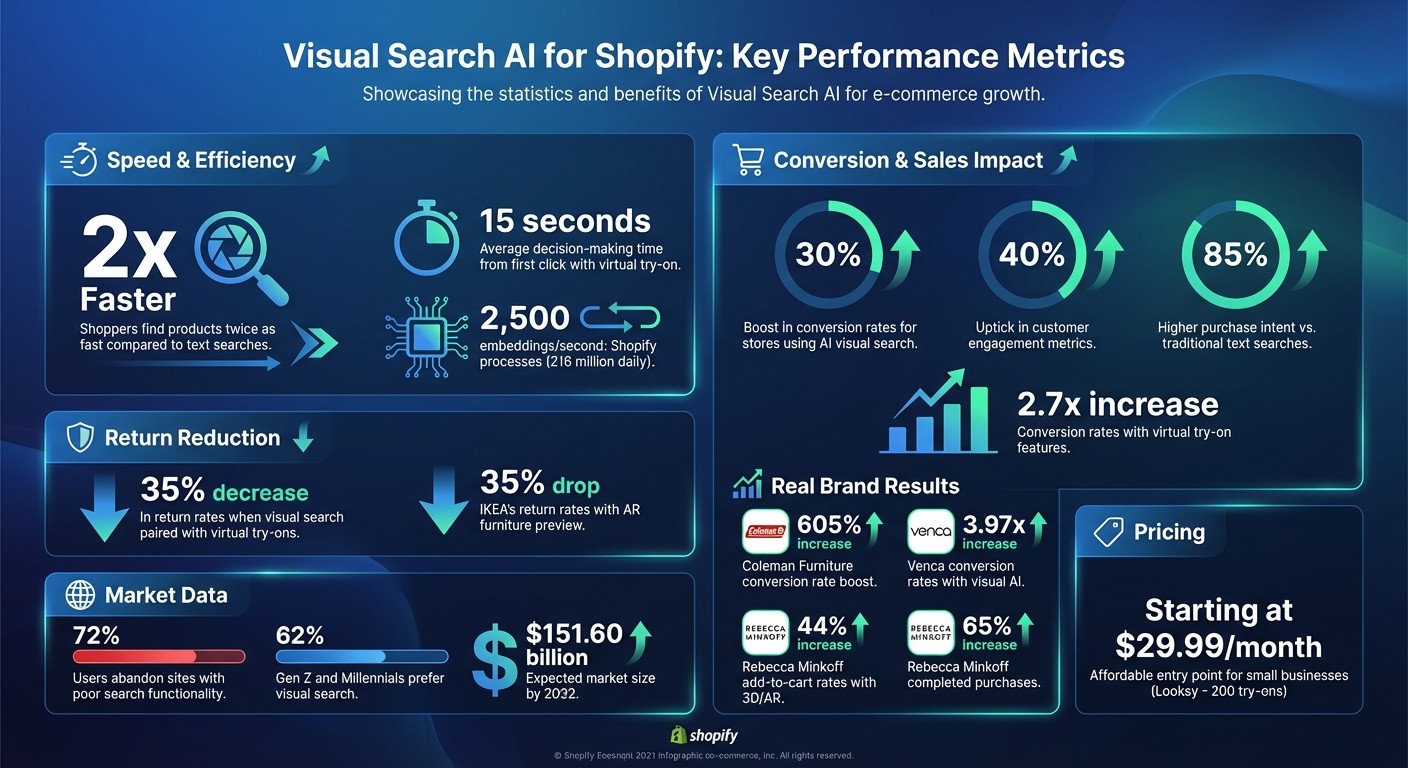
Visual Search AI Impact on Shopify Store Performance and Conversions
How Visual Search AI Works on Shopify
Technologies Behind Visual Search
Visual search AI relies on a combination of sophisticated technologies to interpret and analyze visual data. At its core, computer vision allows machines to process and “see” digital images, while deep learning and convolutional neural networks (CNNs) mimic how the human brain recognizes patterns. This process unfolds in three main steps:
Feature Extraction: The image is broken down into key characteristics - like color, shape, texture, and patterns - to generate a unique digital “fingerprint.”
Object Detection: Specific items within the image are identified and located.
Similarity Matching: The system compares the image’s digital signature to a product catalog, ranking items based on how closely they match.
Shopify enhances this process with a system called embeddings. According to Jonathan Sabbagh from Shopify Engineering, embeddings “translate textual and visual content into numerical vectors in a high-dimensional space. This transformation allows us to measure the similarity between different pieces of content… enabling more accurate and context-aware search results”. Shopify’s infrastructure processes a staggering 2,500 embeddings every second - totaling around 216 million daily - to ensure search results stay up-to-date as merchants continually add new products.
Shopify Integration Options
Shopify makes it easy for store owners to integrate visual search into their websites, thanks to a variety of AI tools for Shopify stores. One popular option is using pre-built apps from the Shopify App Store, such as Visual Search by Shopix or Layers. These apps require no coding and automatically sync with your product catalog. For instance, Visual Search by Shopix offers a $29/month Growth plan, which includes unlimited products, images, and searches. These tools work by analyzing product images, generating tags, and updating the store’s search index via Shopify’s API. This process also enables smart collections, which automatically group similar items.
For merchants who want more customization, API-based solutions using platforms like Clarifai or Amazon Rekognition provide advanced functionality. However, these require technical expertise to implement. To ensure accurate matches, it’s crucial to use high-resolution photos taken from multiple angles, along with detailed metadata like alt text, captions, and product attributes.
Benefits of Visual Search AI for Shopify Stores
Better Product Discovery and Customer Engagement
Visual search removes hurdles, taking the customer directly from inspiration to gratification.
This quote from Wanda Gierhart, former Chief Marketing Officer at Neiman Marcus, highlights how visual search simplifies the shopping journey. Instead of typing out long, clunky descriptions - like “blue flowery dress with sleeves” - shoppers can upload a photo and instantly find what they’re looking for. This ease of use is a game-changer, especially considering that 72% of users abandon sites with poor search functionality.
The results speak for themselves. Stores using AI-driven visual search report a 30% boost in conversion rates and a 40% uptick in customer engagement metrics. Shoppers using visual search also show 85% higher purchase intent compared to those relying on traditional text searches, as demonstrated by ASOS’s “Style Match” tool. By analyzing visual elements like color, texture, and pattern, the technology uncovers products that might otherwise go unnoticed due to incomplete or inconsistent tagging.
Take Rebecca Minkoff as an example. After integrating 3D and AR visualization for handbags on their Shopify store, they saw a 44% increase in add-to-cart rates and a 65% jump in completed purchases. CEO Uri Minkoff explained:
3D media makes for a much more interactive shopping experience. Customers can examine our products from every angle… which helps them get a better sense of quality, size, and other details that matter.
By making product discovery more intuitive and engagement more interactive, visual search AI creates a smoother shopping experience that leads directly to checkout.
Lower Cart Abandonment Rates
One of the biggest hurdles in e-commerce is cart abandonment, often caused by slow or frustrating search experiences. Visual search AI tackles this head-on by cutting the time it takes to find the right product in half. For U.S. shoppers, who frequently abandon carts when the shopping process drags on, this speed can make all the difference. By delivering precise results in seconds, visual search eliminates the friction that causes customers to give up.
It also reduces the overwhelming clutter of nearly identical search results, helping shoppers make decisions faster. For Shopify stores that incorporate virtual try-on AI, the benefits are even more pronounced. These stores give shoppers a visual answer at the moment of hesitation, so fewer of them leave the page to think it over.
By streamlining the search process and making it more precise, visual search AI not only accelerates checkouts but also leaves shoppers feeling more satisfied with their experience.
Higher Customer Satisfaction and Fewer Returns
Visual search AI becomes even more effective when paired with virtual try-on tools. These features help customers make better decisions before they buy, reducing high return rates and the chances of dissatisfaction later. For instance, IKEA’s 2019 update allowed users to preview furniture in their own spaces through photos. This feature led to a 35% drop in return rates among users compared to those who didn’t use it.
On Shopify, tools like Looksy’s AI-powered virtual try-on take this concept further. Shoppers can see how products will look on them instantly - no downloads or sign-ups required. This builds confidence in fit, style, and overall appearance. Looksy integrates seamlessly with Shopify, provides detailed performance analytics, and prioritizes customer privacy. With a free plan and paid plans starting at $14.99 per month, it’s an affordable way to reduce returns while boosting customer satisfaction through better pre-purchase visualization.
Case Studies: Visual Search AI Results
Small and Mid-Sized Store Results
Coleman Furniture saw impressive results after adopting Syte‘s visual AI solutions between 2020 and 2021, under the guidance of Michael Stein, Head of Ecommerce. This move led to a 605% increase in conversion rates and a 29% rise in average order value. Stein highlighted the impact by saying:
“If you start looking at sofas, and you see that there are 2,000 options, by the time you get to 20 you’re going to be exhausted. Instead, we know that if someone is looking for a mid-century modern sofa, we can prune 95% of the catalog in a matter of seconds.”
By streamlining the search process, visual AI helped shoppers quickly zero in on what they wanted, cutting through the overwhelming number of choices.
Similarly, Meesho, an Indian e-commerce platform, integrated ViSenze’s Smart Visual Search to cater to younger shoppers looking for celebrity-inspired styles. As of 2024, the platform handles nearly one billion visual searches annually. This widespread use underscores how visual search makes finding products easier and speeds up purchasing decisions.
These examples illustrate how visual search can deliver tangible benefits, even for smaller or mid-sized stores.
Large Brand Implementations
Larger brands are also reaping the rewards of visual AI. Take Venca, one of Spain’s top 10 fashion retailers. After introducing Syte’s visual AI platform in 2024, the company achieved a 3.97x increase in conversion rates. When combining visual and textual search, conversions jumped to 8x higher than traditional methods, with shoppers spending 3.9x more time browsing the site. Jordi Badia, CIO-CDO Digital at Venca, likened the experience to in-store shopping:
“Using visual search is like shopping at a physical store. By using real-world photos, we transform online product search into something that can be more personal and close to reality, even in the digital world.”
Volcom, a Shopify brand, also saw significant gains, achieving a 3.5x increase in conversion rates through AI-driven personalized experiences. Meanwhile, Marc Jacobs now attributes 9% of its total online revenue to AI-powered tools that customize the shopping experience for each customer.
These success stories highlight how visual AI is not just a tool for better search; it’s a driver of deeper customer engagement and measurable revenue growth for brands of all sizes.
Looksy‘s Visual Search AI Solution
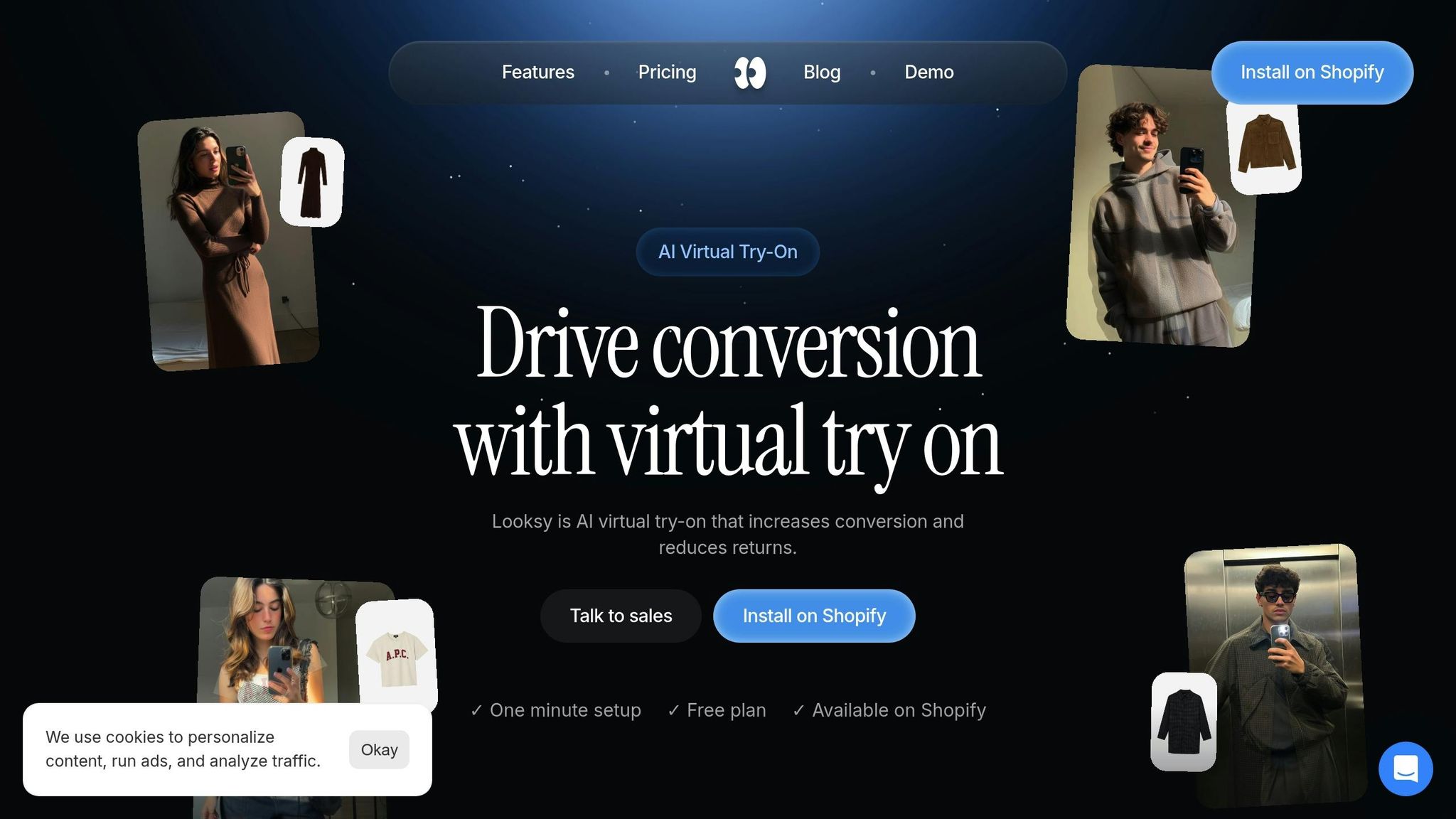
Looksy Features
Looksy takes visual search AI to the next level by offering a virtual try-on experience that transforms product discovery. This feature allows customers to see how products look on them, removing doubts about fit or style.
Here’s how it works:
Click the “Try On” button.
Upload a photo.
Instantly view lifelike results directly in the browser - no downloads or sign-ups needed.
This streamlined process helps users make decisions fast - typically within 15 seconds. Merchants using Looksy can measure the results for themselves, with reporting on try-on activity, engagement, and how it relates to conversion.
What sets Looksy apart is its native UI integration. The try-on button blends seamlessly into your product gallery, adopting your store’s CSS and design. This ensures it feels like a natural part of your website, not a clunky third-party add-on. Plus, Looksy works effortlessly with Shopify, reinforcing its ease of use for merchants. Michael from Maison Beast, an Estonian brand, shared his experience:
Looksy integrates the try on button directly into the product pictures which is the most easiest and cleanest integration of this feature I’ve ever seen.
Looksy prioritizes speed and privacy, loading only when the try-on button is clicked. It processes photos instantly without storing them. Merchants can also access detailed analytics to track try-on activity, customer engagement, and conversion trends.
Pricing Plans
Looksy offers flexible pricing options tailored to stores of all sizes. Paid plans are based on usage, measured in try-on credits, and there is a free plan with unlimited try-ons:
Plan | Monthly Price | Included Try-Ons | Overage Fee | Best For |
|---|---|---|---|---|
Free | Free | Unlimited try-ons | Not applicable | New stores testing virtual try-on, with Looksy branding |
Starter | $14.99/month | 100 photo credits | $0.14 each | Growing stores that want Looksy branding removed |
Growth | $29/month | 300 photo credits | $0.12 each | Established brands with steady traffic |
Scale | $79/month | 600 photo or video credits | $0.10 each | High-volume stores needing realtime video try-on |
New users can get started with a free plan that includes unlimited try-ons, capped instead by up to $100 of additional revenue. Looksy has earned a 4.6/5 rating from 6 reviews on the Shopify App Store, with users praising its realistic AI rendering and quick setup. Installation takes just one minute, and the tool automatically matches your store’s theme.
Future Developments in Visual Search AI
Multimodal Search Capabilities
Visual search is evolving to combine multiple input types - images, text, and voice. Imagine snapping a photo, then typing, “like this, but in red”, or refining results with a simple voice command. This approach mimics how we naturally communicate, making shopping more intuitive.
The technology behind this is called multimodal fusion, which translates inputs like images, text, and voice into a shared format. This allows AI to grasp not only the visual elements of a photo but also abstract concepts such as “minimalist” or “earthy”. Shopify is already scaling this technology. By 2025, their Global Catalogue will process 10 million product updates daily using multimodal Large Language Models. These models can extract details like color hex codes and materials directly from images, performing 40 million AI-powered inferences daily while reducing processing time to just 500 milliseconds.
For businesses, this means customers can find exactly what they’re looking for without needing to guess keywords. They can upload a screenshot from Instagram or describe their vision, and the AI will interpret it. With 62% of Gen Z and Millennials preferring visual search and the market expected to hit $151.60 billion by 2032, integrating multimodal capabilities is becoming increasingly important.
To prepare, businesses should focus on:
High-resolution product photos (minimum 1,200×1,200 pixels) from various angles.
Descriptive file names like “black-leather-crossbody-bag.jpg.”
Adding schema markup to help AI systems understand product details.
This shift toward multimodal inputs creates a more personalized and seamless shopping experience.
Personalization and Context Understanding
The next major step for visual search is understanding shopper intent and context. As Lior Delouya, Director of Product at Dynamic Yield, explains:
Visual search is no longer just about recognizing objects. It is about recognizing intent.
AI is now capable of adapting to real-time inputs from shoppers, analyzing preferences such as colors, textures, and patterns to build a personalized style profile. Advanced systems can even account for environmental factors, like lighting or room decor, to recommend products that fit a specific space.
This deeper understanding of intent is already driving results. Retailers using AI-powered visual search tools have seen conversion rates increase by up to 30%. Additionally, visual search leads to checkouts twice as fast as traditional text-based searches. Rebecca Minkoff, for example, integrated 3D media and AR into their Shopify store in 2024. Customers who interacted with these tools were 44% more likely to add items to their cart and 65% more likely to complete a purchase. Uri Minkoff, the brand’s cofounder and CEO, highlighted the benefits:
3D media makes for a much more interactive shopping experience. Customers can examine our products from every angle… which helps them get a better sense of quality, size, and other details that matter.
In the near future, a single lifestyle photo could allow shoppers to purchase every item it features - whether it’s furniture in a room or accessories in an outfit.
To stay ahead, businesses should:
Clean and organize product metadata.
Integrate visual search with recommendation engines.
Optimize for mobile platforms to enhance user experience.
Conclusion
Visual search AI is changing the way Shopify stores engage with their customers. Instead of typing in keywords, shoppers can simply upload a photo to find exactly what they want. Retailers using AI-powered visual search tools report higher conversion rates, and customers are reaching checkout twice as fast compared to using traditional text searches.
This technology doesn’t just save time - it redefines the shopping experience. Over 85% of online shoppers prefer visual content over text when purchasing items like clothing or furniture. As industry experts have pointed out, visual search makes it easier for customers to move seamlessly from inspiration to purchase.
Visual search tools also cut costs and build buyer confidence. Features like virtual try-ons significantly boost both engagement and completed purchases.
Plus, this technology is within reach for businesses of all sizes. For example, Looksy’s Shopify app has a free plan with unlimited try-ons, and paid plans start at $14.99 per month, making it an affordable option for small retailers in high-demand categories. Automated product tagging can also reduce operational costs by as much as 25%.
FAQs
What kinds of product photos make visual search more accurate?
High-quality product photos play a big role in improving visual search accuracy. To achieve this, make sure your images are clear, well-lit, and focused. Highlight key details like distinct colors, patterns, textures, and styles to give users a precise visual reference. Additionally, pay attention to composition and ensure the product is represented accurately for the best results.
Will visual search AI slow down my Shopify store speed?
Using visual search AI tools like Looksy might have a small impact on your Shopify store’s speed because of the extra code and processing involved. That said, these tools are designed to be efficient, keeping query times at around 40–50 milliseconds, which helps minimize any noticeable slowdown. Plus, developers are always working to improve these systems, ensuring they run quickly and smoothly.
How can I measure ROI from visual search and virtual try-on?
To evaluate the return on investment (ROI) from visual search and virtual try-on, focus on key metrics like sales growth, return rates, and customer confidence. Tools such as ROI calculators can help you estimate outcomes by analyzing data points like conversion rates and average order value.
Virtual try-on can move both of those numbers by helping shoppers picture the item before they buy, so record your own baseline before launch and compare after. These figures provide a clear way to quantify its financial impact and demonstrate its value to your business.