Ecommerce
Virtual Try-On vs. In-Store Fitting: Privacy and Trust
Compare virtual try-on and in-store fittings on privacy, trust, biometric risks, legal rules like BIPA, and when each option best reduces returns.

Shopping for clothes has never been more divided between convenience and concerns about privacy. Virtual try-on tools promise accurate sizing and ease, but they collect sensitive biometric data, raising questions about security. In-store fitting rooms offer a physical experience but come with visible privacy risks like surveillance.
Here’s the dilemma:
Virtual try-ons: Use AI and 3D scanning to improve fit accuracy but require biometric data like facial geometry and body measurements. Privacy laws like BIPA demand explicit consent and data transparency.
In-store fittings: Offer a tactile experience without digital data collection but may feel intrusive due to cameras or staff presence.
Key stats to know:
42% of online apparel returns stem from fit issues.
81% of consumers worry about data misuse with virtual tools.
Virtual try-ons can reduce return rates by up to 27%.
Quick Comparison:
Aspect | Virtual Try-On | In-Store Fitting |
|---|---|---|
Privacy Risks | Biometric data storage | Cameras or staff presence |
Convenience | Accessible anytime, anywhere | Requires physical store visit |
Fit Accuracy | AI-driven sizing | Hands-on fabric and fit testing |
Trust Factors | Legal frameworks like BIPA | Visible safeguards and staff help |
Both methods have pros and cons, and the choice depends on your priorities: convenience and tech-savvy privacy for virtual tools or tactile experience and immediate feedback in-store.
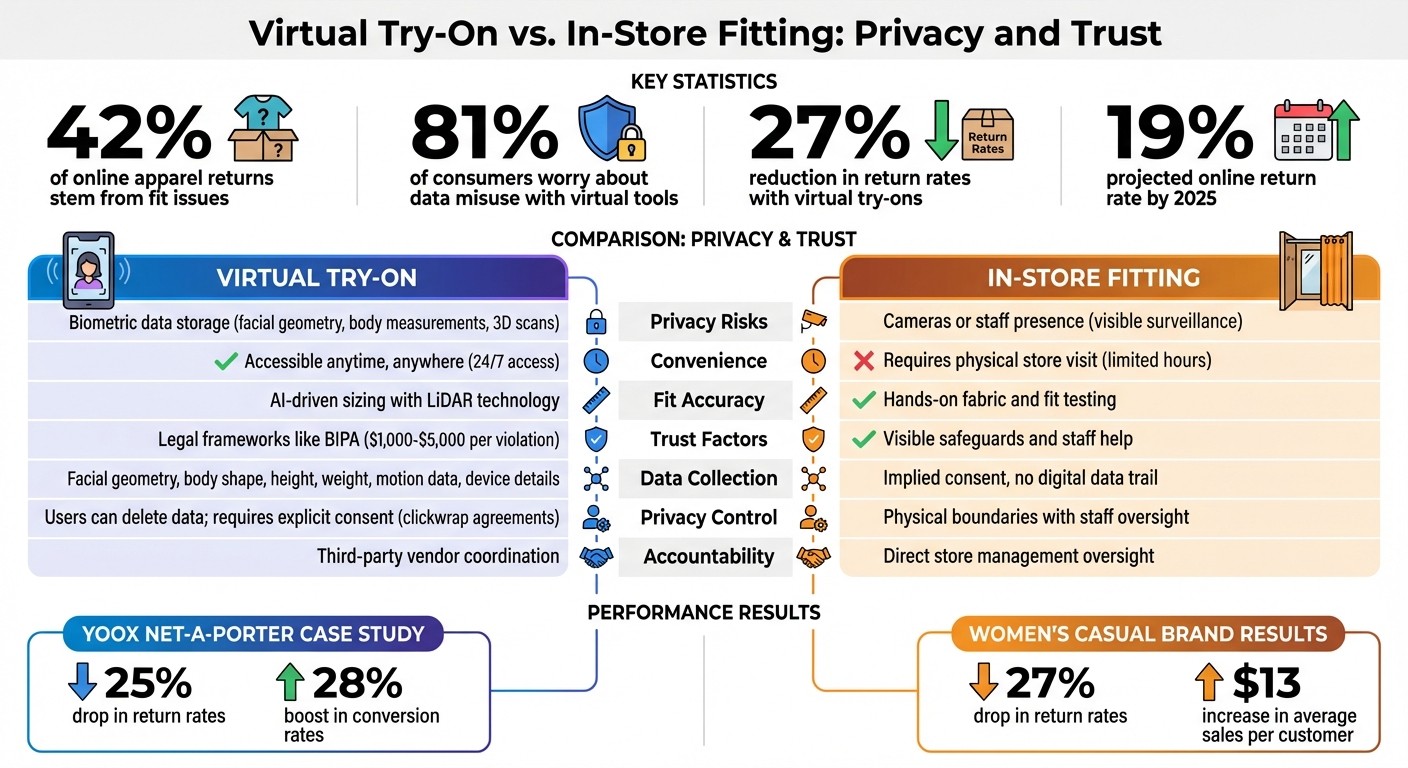
Virtual Try-On vs In-Store Fitting: Privacy, Trust and Performance Comparison
How Privacy Differs in Virtual Try-On and In-Store Fitting
When it comes to privacy, virtual try-on tools and in-store fittings present distinct challenges. While physical fitting rooms expose shoppers to visible privacy risks like surveillance or unwanted onlookers, virtual try-on tools introduce concerns about the collection and handling of sensitive digital data.
Virtual Try-On: Data Collection and Privacy Risks
Virtual try-on technology gathers far more than a simple snapshot. These tools often collect biometric data, such as facial geometry scans and detailed 3D body measurements, including height, weight, body shape, and bust size. Some apps even utilize advanced LiDAR sensors - like those found in the iPhone 12 Pro and newer models - to create highly precise 3D models.
Beyond this, virtual try-on systems capture live video, motion data, and device-specific details, creating a lasting digital record of a user’s physical features. This level of data collection raises serious privacy concerns, especially since many retailers rely on third-party vendors to process this information. This reliance on external operators can blur the lines of accountability, leaving consumers wondering who truly controls their biometric data.
Legal frameworks like the Illinois Biometric Information Privacy Act (BIPA) aim to address these risks. Under BIPA, companies can face penalties of $1,000 for each negligent violation and $5,000 for reckless or intentional violations. Recent court cases, such as Theriot v. Louis Vuitton N.A. and Kukovec v. Estée Lauder Companies, Inc., have emphasized the importance of informed consent and clear policies for data retention and destruction.
Retailers are now required to use “clickwrap” agreements - where users actively consent by clicking - rather than passive “browsewrap” methods. They must also publish transparent policies explaining how long data is retained and when it will be permanently deleted. These measures are designed to provide users with greater control over their personal information.
Data Category | Data Points Captured | Collection Method |
|---|---|---|
Biometric | Facial geometry, body shape, bust size, skin color | 3D scanning, facial mapping |
Visual | Front/side photos, live video, 3D avatars | Device camera, LiDAR |
Physical | Height, weight, motion data | User input, motion tracking |
Technical | Device details and usage patterns | Mobile app/web interface |
The risks tied to virtual try-on tools highlight the need for robust privacy safeguards. These digital concerns stand in stark contrast to the more visible and immediate privacy issues found in physical fitting rooms.
In-Store Fitting: Data Collection and Physical Privacy
On the other hand, in-store fittings come with their own set of privacy challenges, though these are often more tangible. Traditional fitting rooms may expose shoppers to concerns about physical vulnerability, interactions with staff, and the presence of surveillance cameras. Unlike the invisible data collection of virtual try-ons, these privacy risks are typically more apparent.
However, the integration of technology into physical stores is beginning to blur these lines. Innovations like “Smart Fitting Rooms” and “Interactive Mirrors” are introducing elements of digital surveillance into what used to be private spaces. For example, tools like the Responsive Mirror use controlled video feeds to let shoppers compare outfits, a feature that researcher Maurice Chu described as creating “a tension between privacy and publicity”.
In physical stores, consent is often implied simply by entering the premises. However, digital enhancements, such as smart mirrors, usually require explicit user interaction, which helps create a clearer boundary between passive surveillance and active data collection.
Unlike virtual try-on tools, where data can be stored indefinitely or shared with third parties, privacy concerns in physical fitting rooms are more immediate and visible. Shoppers can see cameras, are aware of staff presence, and can choose when to leave the fitting room. Both environments, however, require clear privacy policies to ensure trust and transparency.
Comparing Trust and Safety in Virtual and In-Store Fitting
Customer trust thrives on a sense of control - whether it’s over personal data or physical space. Virtual try-on tools and in-store fittings each offer unique strengths and weaknesses in this regard. While virtual options face challenges like the permanence of biometric breaches, physical fittings come with their own set of privacy concerns. Let’s dive into how these two approaches foster trust in their distinct ways.
Trust Factors in Virtual Try-On Tools
Virtual try-on tools aim to build trust by prioritizing transparency and giving users direct control over their data. Take Google’s “Try-On” tool, launched in the U.S. in 2024, as an example. It ensures that no biometric data is collected or stored, avoids using customer photos to train AI, and even allows users to delete their photos with a simple click of a camera icon. Research involving 285 consumers highlights that personalization features and responsive controls significantly reduce privacy concerns.
Legal protections like the Biometric Information Privacy Act (BIPA) further bolster trust. Jeffrey H. Greene, a Partner at Foley & Lardner LLP, advises:
“Companies should also consider implementing a user agreement prompt that must be agreed upon before accessing the virtual try-on feature and includes language of where the biometric data is being stored and for how long.”
Some companies excel in this privacy-first approach. Looksy, for instance, processes try-on requests instantly without requiring downloads or sign-ups. The financial upside is clear too. When Yoox Net-a-Porter tested Deepgears’ virtual try-on technology with 90 styles from its Mr P. brand in February 2024, they saw a 25% drop in return rates and a 28% boost in conversion rates.
Virtual try-ons rely heavily on digital consent and instant data controls. In contrast, in-store fittings offer a more tactile sense of privacy through human interaction and physical boundaries.
Building Trust in In-Store Fitting Rooms
In-store fittings create trust through visible safeguards and personal interactions. For example, stores like Target use cameras outside fitting rooms to monitor activity and deter theft. Inside the fitting rooms, strict no-video policies protect customer privacy. While only 13 states, including California, New York, and Michigan, have specific laws prohibiting dressing room surveillance without consent, the federal Video Voyeurism Prevention Act provides an additional layer of protection.
Sales associates also play a crucial role. They can address concerns on the spot, provide personalized sizing advice, and ensure customer boundaries are respected - offering a level of accountability that digital tools can’t replicate. However, even physical stores are adopting digital solutions. Nike’s store in China, for instance, combines augmented reality and foot-scanning technology to help customers find the perfect shoe size, blending physical interaction with digital precision.
Trust Factor | Virtual Try-On | In-Store Fitting |
|---|---|---|
Privacy Control | Users can delete data; requires consent | Physical boundaries with staff oversight |
Transparency | Data storage/usage must be disclosed | Visible camera placement and policies |
Legal Framework | BIPA ($1,000–$5,000 per violation) | Video Voyeurism Prevention Act |
Primary Risk | Persistent breach risk | Immediate privacy exposure |
Accountability | Third-party vendor coordination | Direct store management oversight |
The choice between virtual and in-store fittings ultimately comes down to personal priorities. Some customers value the confidence that comes with robust digital data protections, while others prefer the tangible comfort of traditional in-store privacy measures. Regardless of the method, clear policies, transparency, and respect for customer autonomy are essential for building trust.
When Virtual Try-On or In-Store Fitting is the Better Choice
Choosing between virtual try-on and in-store fitting depends on the product, the shopper’s priorities, and privacy concerns. Each method has its strengths, excelling in different situations. Let’s explore when each approach works best.
Situations Favoring Virtual Try-On
Virtual try-on is ideal for products where appearance matters more than touch or fabric feel. Think eyewear, jewelry, and cosmetics - items that don’t require complicated sizing or texture evaluation. For example, Warby Parker uses Apple’s ARKit and TrueDepth technology to map facial features in real-time, letting customers see how frames fit without ordering multiple pairs for home trials.
The convenience is hard to ignore. Around 81% of shoppers research products online before buying, and virtual try-on helps them make choices from the comfort of home - all while keeping their privacy intact. The financial upside is also noteworthy. A women’s casual brand saw a 27% drop in return rates and a $13 boost in average sales per customer after adopting 3D virtual try-on technology. By reducing the need for customers to order multiple sizes (a practice known as “bracketing”), the brand cut fulfillment costs significantly. With online return rates projected to exceed 19% by 2025, tools like these can make a real difference.
Platforms like Looksy make virtual try-on accessible for Shopify stores, offering unlimited try-ons on the free plan, with paid plans from $14.99 per month - no downloads, no sign-ups, and privacy fully protected.
Situations Favoring In-Store Fitting
While virtual try-on offers convenience, in-store fitting is still essential for products that demand physical interaction. Items like jeans, suits, and structured dresses require customers to feel the fabric, assess weight, and see how the material drapes - things virtual tools can’t fully replicate.
There’s also the human element. In-store, sales associates can provide real-time advice, address fit concerns, and offer personalized recommendations that digital tools lack. For instance, Bloomingdale’s introduced “Body-Sizing Pods” back in 2012, helping shoppers find jeans tailored to their body shape and enhancing the fitting room experience.
Scenario | Better Choice | Why |
|---|---|---|
Shopping for accessories like sunglasses or earrings | Virtual Try-On | Offers visual feedback without worrying about size |
Buying jeans or tailored clothing | In-Store Fitting | Allows for hands-on fabric assessment and fit testing |
Shopping late at night or from home | Virtual Try-On | Provides 24/7 accessibility and convenience |
Making a high-value purchase requiring certainty | In-Store Fitting | Ensures physical confirmation to avoid buyer’s remorse |
Privacy-conscious about body shape | Virtual Try-On | Lets shoppers browse styles without sharing personal measurements |
Concerned about digital data security | In-Store Fitting | Avoids biometric data collection and leaves no digital trail |
These examples highlight how product type and privacy concerns guide the choice between virtual and in-store fitting. If convenience and privacy are your top priorities, virtual try-on is a game-changer. But when you need to feel the fabric, want instant feedback, or prefer avoiding digital data risks, in-store fitting is the way to go.
Conclusion: Privacy and Trust as Key Drivers of Customer Choice
When it comes to deciding between virtual try-on tools and in-store fitting rooms, privacy and trust play a massive role in shaping customer preferences. Recent research and legal developments highlight just how important data privacy is for consumers to embrace virtual try-on technology.
The key lies in transparency and giving customers control. Jeffrey H. Greene, Partner at Foley & Lardner LLP, puts it clearly:
“Retailers must inform consumers when and how their biometric data is being collected and provide them with an opportunity to decline collection”.
In an environment where explicit consent and clear data policies are non-negotiable, privacy-first solutions are paving the way forward. Tools that prioritize transparency and gain customer consent help bridge the gap between the ease of digital shopping and the familiarity of in-store experiences.
Looksy is tackling these issues head-on. By offering a virtual try-on tool that requires no downloads or sign-ups and ensures transparent data handling, Looksy puts privacy at the forefront. Starting with a free plan that includes unlimited try-ons, and paid plans from $14.99 per month, Looksy provides Shopify retailers with an easy and privacy-focused solution.
As we move forward, the retailers who succeed will be the ones who find the sweet spot between cutting-edge technology and customer trust. With growing consumer demand for both convenience and privacy protection, building trust through privacy-first practices will remain a decisive factor in whether shoppers choose virtual or in-store fitting. At the end of the day, confidence in privacy practices is what drives customer loyalty - whether online or offline.
FAQs
How is my privacy protected when using virtual try-on technology?
Virtual try-on tools let you see how products will look on your face or body by using photos you provide. Since this process involves biometric data, retailers must adhere to strict privacy regulations. This includes getting your consent, being transparent about how your data will be used, and securely storing and deleting it when it’s no longer needed. These steps are designed to safeguard your personal information and build trust.
Take Looksy, for instance. It offers a secure and hassle-free experience by not requiring downloads or sign-ups, keeping your data private while making online shopping more convenient.
How is privacy protected in in-store fitting rooms?
In-store fitting rooms are carefully designed to respect and protect customer privacy. Laws like the Video Voyeurism Prevention Act strictly forbid recording in private spaces without explicit consent. To comply, most retailers ensure that fitting rooms remain free of cameras, with any surveillance limited to areas outside the fitting rooms, primarily for theft prevention. These precautions aim to provide shoppers with a secure and stress-free experience.
When is a virtual try-on a better choice than visiting a store for a fitting?
Virtual try-on offers a quick and convenient way to see how a product might look on you - all without stepping out of your home. It’s a fantastic option for those looking to save time, skip the hassle of travel, or shop whenever it suits them, even outside standard store hours.
These tools also focus on privacy and often use advanced AI to provide accurate sizing recommendations. This helps you shop with confidence while minimizing the chances of returns. If you value ease and secure shopping, virtual try-on is a game-changer.