Ecommerce
High Return Rates: 5 Solutions for Online Retailers
Lower e-commerce return rates with AI try-ons, clear size guides, accurate product images and descriptions, smoother UX, and data-driven return analysis.

Online retailers face a growing challenge: high return rates. Nearly 1 in 5 online orders were returned in 2025, costing businesses millions in lost revenue and operational expenses. The main culprits? Poor fit, mismatched expectations, and damaged items. But there’s good news - targeted strategies can help reduce returns and protect profits.
Here are 5 practical solutions to lower return rates:
AI-powered virtual try-on tools: Help customers visualize products before buying, reducing fit-related returns.
Detailed size and fit guides: Provide accurate, clear measurements to minimize sizing issues.
Improved product descriptions and images: Ensure customers know exactly what they’re purchasing.
Enhanced user experience: Simplify navigation and checkout to reduce ordering mistakes.
Data-driven return analysis: Use return data to identify and fix recurring issues.
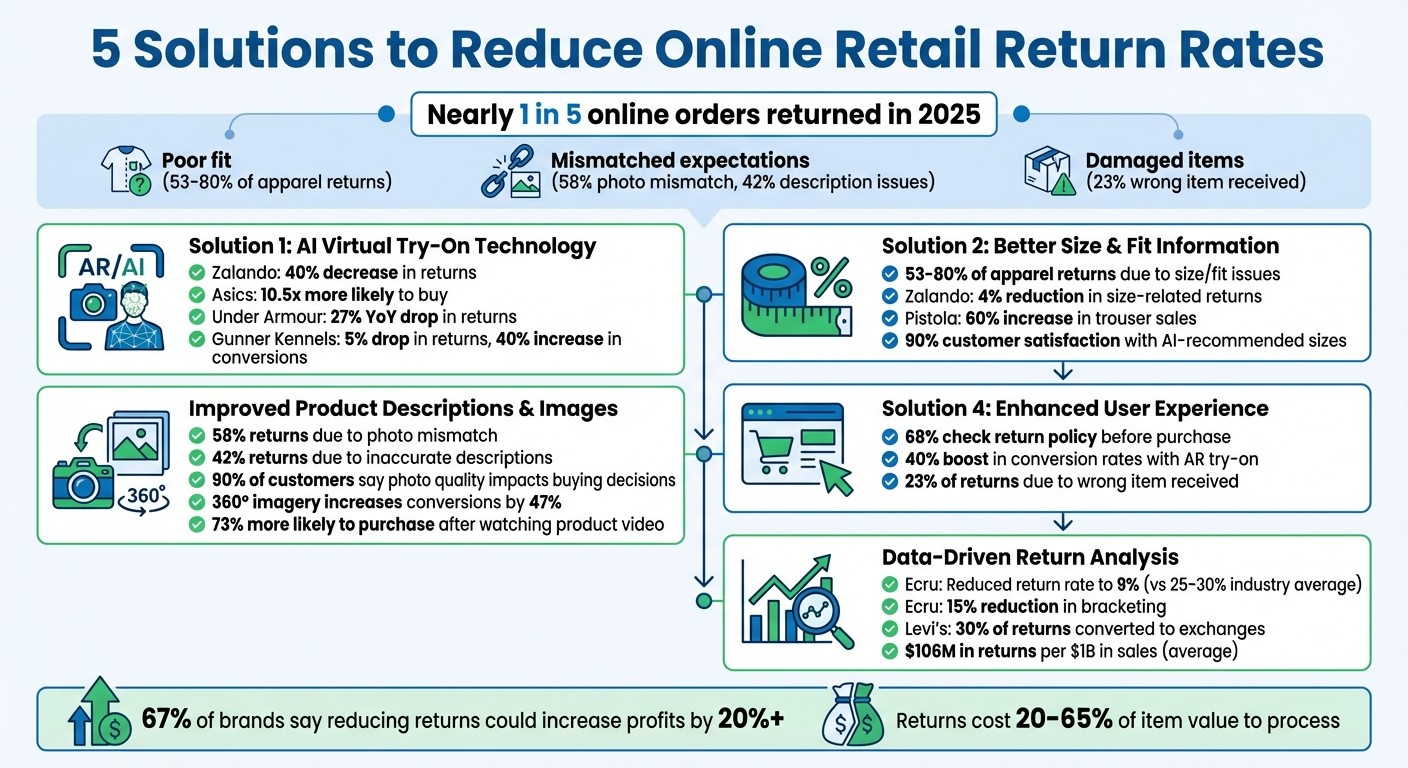
5 Solutions to Reduce Online Retail Return Rates - Key Statistics and Impact
Solution 1: Add AI Virtual Try-On Technology
AI-powered virtual try-on technology offers shoppers a way to preview how products will look before making a purchase. Instead of guessing whether that dress will fit or if those sunglasses will match their face shape, customers can simply upload a photo and get an instant preview. This removes much of the guesswork that often leads to returns.
How Virtual Try-On Technology Works
Virtual try-on systems combine augmented reality (AR) and artificial intelligence (AI) to create lifelike previews of products. AR uses your device’s camera and motion sensors to map facial or body landmarks in real time, allowing items like makeup, eyewear, or clothing to appear virtually on a live feed. Meanwhile, AI processes photos and basic details - such as height, weight, and age - to calculate body dimensions and recommend sizes. Some advanced systems even generate digital avatars to simulate how fabric will drape on a person.
Most of these solutions are browser-based, using WebAR or mobile-friendly widgets, so there’s no need for customers to download an app. This easy accessibility makes it even more appealing for online shoppers. By removing the uncertainty around sizing and style, these simulations directly help reduce return rates.
How Virtual Try-On Reduces Returns
Virtual try-on technology has already proven its ability to lower return rates significantly. For example:
Zalando reported up to a 40% decrease in returns during pilots of its virtual fitting room technology.
Shoppers using virtual fitting tools on the Asics website were 10.5 times more likely to buy.
Under Armour saw a 27% year-over-year drop in returns.
Considering that 70% of fashion returns are caused by issues with fit or style, allowing customers to see how items look on themselves - or on a digital avatar - removes much of the guesswork. It also discourages the common practice of ordering multiple sizes “just in case.”
As Shopify explains:
“Virtual fitting rooms reduce uncertainty about fit and style - two of the biggest barriers to online purchasing - helping customers commit with confidence.” - Shopify
Setting Up Looksy on Your Shopify Store
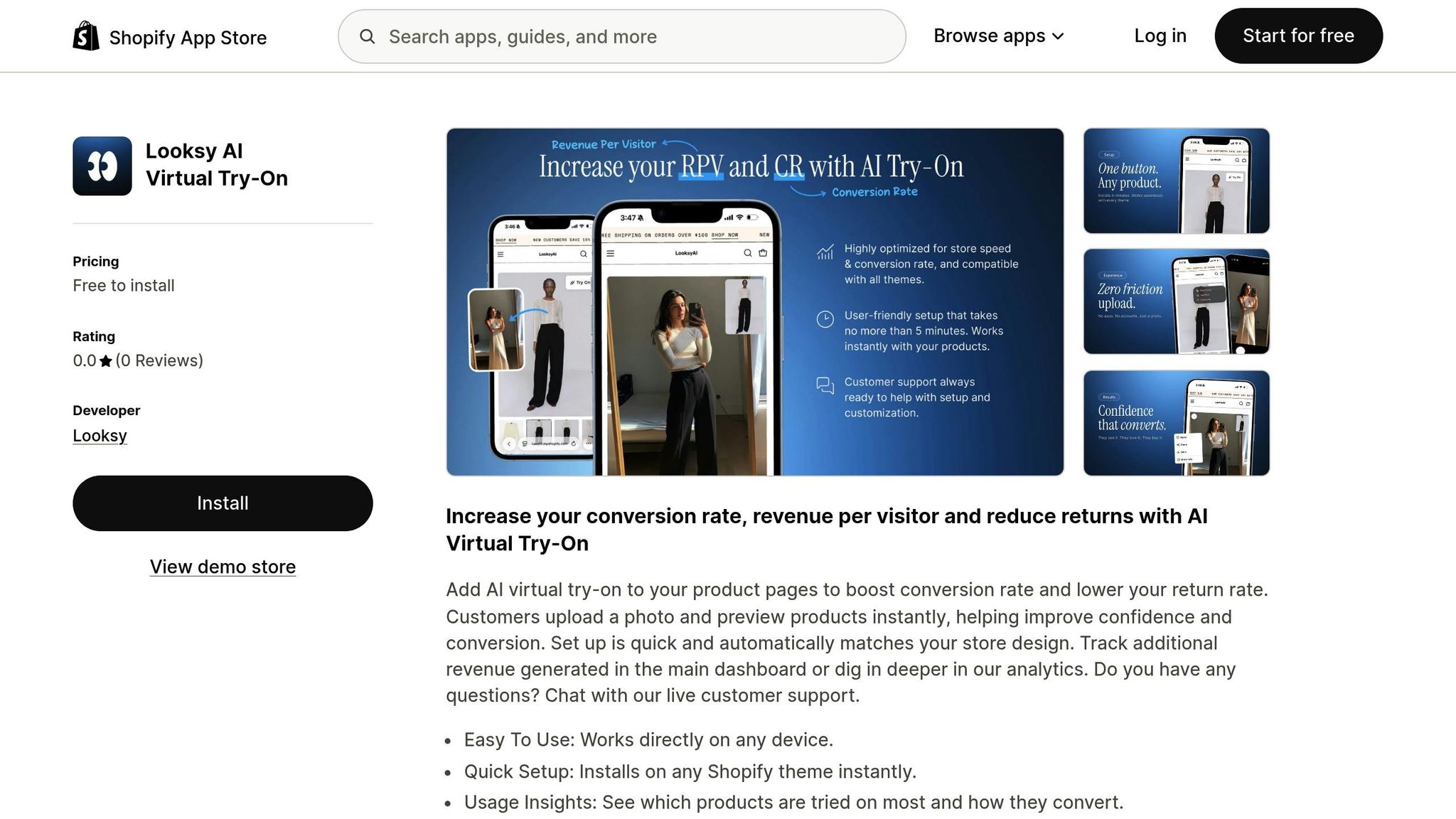
Adding Looksy to your Shopify store is straightforward. The platform integrates directly with Shopify themes and works seamlessly with your existing product catalog. Here’s how to get started:
Install the Looksy app from the Shopify App Store.
Add a clear “Try it on now” button to your product pages.
Use high-quality images and standardized size charts (e.g., “waist_inch”, “chest_circumference”) to ensure accurate AI predictions.
Start with a pilot category and monitor its performance. For smooth mobile experiences, keep 3D models under 5MB.
Looksy offers a free plan with unlimited try-ons, plus paid plans starting at $14.99/month for 100 photo try-on credits, with additional credits at $0.14 each. Higher-volume plans are available at $29/month and $79/month, with the top plan adding realtime video try-on.
Solution 2: Provide Better Size and Fit Information
Did you know that roughly 53% of online apparel returns - and up to 80% for some retailers - are due to size or fit issues?. The challenge isn’t just that customers can’t try on items before buying; it’s that many size guides fail to provide the detailed information shoppers need. To tackle this, brands need to focus on creating clearer size guides and leveraging data to address fit-related concerns.
How to Create Clear Size Guides
A good size guide goes beyond vague labels like “Small” or “Medium.” Instead, use precise measurements and detailed descriptions. For example, instead of “Medium”, list it as “Size 8–10” and include standard body measurements like bust, waist, hips, and height. For specific items, add garment-specific details: jeans should include inseam and thigh circumference, while tops should note armpit-to-armpit width and sleeve length. Clearly state whether the item is fitted, oversized, or loose, and mention fabric stretch. Finally, make sure the size guide is easily accessible on every product page.
“Sizing is frequently the number one reason shoppers cite in their decision to shop in-store versus online.” – Dan Weinsoft, Ecommerce Conversion Strategist, The Good
Using Return Data to Fix Sizing Problems
Return data can be a goldmine for identifying and solving fit issues. If a particular item is frequently returned with comments like “too small”, it’s a clear sign the size chart or product description needs tweaking. For example, in September 2019, Zalando used fit models and customer feedback to address sizing inconsistencies, which led to a 4% reduction in size-related returns.
It’s also helpful to monitor patterns among different customer groups. If men are primarily returning items for being “too small” while women are returning them for being “too big”, it’s a strong indicator that the sizing information isn’t aligned with customer expectations.
“If you find that you’re getting many returns on a certain sized item, it may indicate that the sizing is not accurate to what customers expect. This kind of data needs to be directed back to the supply chain for better product sourcing.” – Radial Team
Tools That Recommend the Right Size
AI-powered size recommendation tools are transforming how brands address fit issues. These tools use basic metrics like height, weight, age, and usual US size to predict a shopper’s best fit. For example, Under Armour saw a 27% drop in return rates year-over-year after implementing an AI sizing tool. Meanwhile, Asics experienced a 10.5 times increase in purchase likelihood when customers used AI fit recommendations.
Amazon’s Fit Insights tool is another example. Available to US brands in the Brand Registry with at least 100 units sold in 12 months, this tool analyzes customer reviews and return data to flag sizing issues and suggest fixes. Impressively, 90% of customers reported satisfaction when purchasing an AI-recommended size. For Shopify users, similar apps are available, with pricing ranging from $129 to $549 per month.
In 2022, denim brand Pistola used AI-driven fit data from Stitch Fix to analyze how fit varied across fabrics and washes. Armed with this insight, they expanded their size range, resulting in a 60% increase in trouser sales. The takeaway? Rely on real customer data - not generic assumptions - to guide your sizing recommendations. These tools, when combined with clear size guides and return data analysis, can significantly reduce returns and boost customer confidence.
Solution 3: Write Better Product Descriptions and Show Better Images
After addressing virtual try-on and sizing tools, the next step to cutting down return rates is improving product descriptions and images. Did you know 58% of returns happen because the product photos don’t match the actual item, and 42% are due to inaccurate descriptions? When customers shop online, they rely entirely on what they see and read. If those elements miss the mark, it often leads to disappointment - and costly returns.
How to Write Clear Product Descriptions
A great product description answers all the questions a shopper might have. Start with specific measurements rather than generic size labels. For example, if you’re selling furniture, include dimensions in feet and inches and provide the weight in pounds. Be upfront about what’s not included - like mentioning if batteries or accessories aren’t part of the package - to avoid “missing item” complaints.
Details about materials are equally important. Don’t just say “cotton blend”; break it down. For instance, “95% cotton, 5% spandex with a soft, breathable texture” gives shoppers a clear idea of the fabric’s feel and stretch. Include care instructions, too, like “Machine wash cold, tumble dry low” - this sets expectations for how to maintain the product. If your return data reveals trends, such as a jacket that customers often say “runs small”, add a note directly on the product page: “This item runs small; consider ordering one size up”.
“The more informed a shopper, the less likely they will receive their goods and be disappointed or surprised.” – 1WorldSync
Clear descriptions are just one piece of the puzzle. High-quality visuals are just as essential for helping customers make confident decisions.
Using Quality Photos and Videos
It’s no surprise that 90% of customers say photo quality impacts their buying decisions. Yet, many retailers still use blurry or poorly lit images. High-quality photos from multiple angles are a must. Show the product from the front, back, sides, and include close-ups of details like stitching or fabric texture. Incorporating 360-degree spin imagery can increase conversions by up to 47%.
Contextual images also make a big difference. For example, display a sweater on a model and include details like the model’s height and size. Show a coffee maker placed on a kitchen counter or a backpack being worn. These visuals help customers imagine the product in their own lives. For items with multiple variants, provide high-resolution images for each option so there’s no guesswork. Videos are even more effective - 73% of shoppers are more likely to purchase after watching a product video, especially for items that require assembly or have unique features.
“Blurry photos or poor lighting can be misleading about an item’s true quality, color, or details.” – Rebecca Fox, Product Marketing Manager, ReturnGO
Matching Try-On Previews with Product Photos
To take things further, ensure your virtual try-on previews align seamlessly with your product photos. When using AI-powered try-on tools, consistency between the preview and the actual product image is key. Advanced AI technology captures fabric details, ensuring the digital preview mirrors the physical item.
AI try-ons also enhance the shopping experience by showing products on models that reflect the customer’s body type, size, and skin tone. For the best results, upload high-resolution source images with proper lighting so the AI can accurately render textures and colors. When try-on previews match the product photos, customers are less likely to feel misled. This alignment helps reduce “not as described” returns, which account for 22% of e-commerce returns.
Solution 4: Make Your Store Easier to Use
A confusing website can lead to more returns. When customers struggle to find what they need or feel rushed during checkout, mistakes are bound to happen. For instance, 23% of returns occur because shoppers receive the wrong item - a common result of errors made during a chaotic shopping experience. By creating a smoother, more user-friendly store, you can help customers make better choices right from the start.
Simplify Navigation and Checkout
Clear navigation is key. Use well-organized categories, filters, and a reliable search function to help customers quickly locate what they’re looking for. For mobile shoppers, adding features like personalized sizing suggestions - based on height and weight - can cut down on “bracketing” (buying multiple sizes to try at home).
When it comes to checkout, keep it simple. Eliminate unnecessary steps and include helpful tools like size finders or chatbots for last-minute questions. Allow customers to make changes with “Edit” or “Cancel” buttons on the order confirmation page, so they can fix mistakes before their order ships.
“A customer’s misbegotten order doesn’t have to become another ecommerce return statistic. Offering customers a clear and easy way to back out of an order might seem counterintuitive, but imagine their sense of relief when they realize they can quickly rectify a mistake.” – Pitney Bowes
These changes in navigation and checkout lay the groundwork for clearer policies and smarter try-on solutions.
Write Clear Return and Exchange Policies
Did you know that 68% of shoppers check a store’s return policy before making a purchase? A policy that’s hard to understand can push customers to abandon their cart or hesitate to buy, which ultimately increases returns. Aim for simplicity. Write your return policy in plain language and, if possible, aim for a Flesch-Kincaid Reading Ease score of 60 or higher. Use bullet points and clear headings to make it easy to skim.
Don’t bury your return policy in the website footer. Highlight key details - like the return window and any fees - on product pages and during checkout. Be upfront about refund timelines to avoid unnecessary follow-up questions.
You can also encourage exchanges instead of refunds. For example, Saks Fifth Avenue offers free returns if initiated within 14 days of the ship date but charges $9.95 for returns after that period. This approach prompts customers to act faster, which helps with quicker restocking.
Improving usability doesn’t stop at checkout or policies - it extends to innovative tools that make trying on products easier.
Using Looksy to Make Try-On Easy
Virtual try-on technology can remove a lot of guesswork for shoppers. Looksy, an AI-powered tool, lets customers instantly see how products will look by simply uploading a photo.
This tool works effortlessly on any device. By showing how clothes drape and fit on different body types, Looksy helps customers understand product fit right away, reducing errors that often lead to returns. Retailers using augmented reality (AR) try-on tools have reported a 40% boost in conversion rates and up to a 40% decrease in returns.
Solution 5: Analyze Return Data to Keep Improving
Lowering return rates isn’t a one-and-done task - it’s an ongoing effort. The most successful retailers use return data as a guide to improve their processes, reduce costs, and enhance customer satisfaction. By tracking key metrics and acting on insights, you can make steady progress in minimizing returns.
What Data to Track
Start by digging into the specific reasons for returns. Instead of generic labels like “didn’t fit”, aim for detailed feedback such as “too tight in the shoulders” or “color darker than expected”. This level of detail helps you identify exactly what needs fixing. Monitor product return rates by SKU, category, and material type to spot patterns that suggest design flaws or misleading descriptions.
Keep an eye on financial metrics as well. Returns can be expensive - processing costs, markdowns, and resale value losses all add up. For instance, the average retailer faces $106 million in merchandise returns for every $1 billion in sales. Understanding these costs, including shipping, labor, and packaging damage, is essential to managing your bottom line.
Don’t overlook customer behavior patterns either. For example, track “bracketing”, where shoppers buy multiple sizes and return the ones that don’t fit, and note how quickly returns are initiated. Grading the condition of returned items (e.g., Grade A for resale-ready, Grade D for disposal) can also reveal whether products are arriving damaged or simply unwanted.
Armed with these insights, you’ll be ready to implement focused improvements.
Creating a System to Act on Feedback
Return data is most valuable when it leads to action. Pair this data with tools like AI virtual try-ons or detailed product descriptions, and map each return reason to a specific fix. For instance, if customers frequently report “color not as expected” or “fit too small”, update product photos to use natural lighting and refine your size guides.
A great example of this approach is Ecru, a women’s fashion brand. In 2021, they partnered with ReturnLogic to analyze return data by fabric type and sales volume. By identifying high-return items and improving product descriptions, they dropped their return rate to 9%, far below the industry average of 25% to 30%. They also reduced “bracketing” by 15%.
“The feedback in return reasons or comments tells me when a product may need adjustment, or if the product description may need to be altered on the website.” – Howard Sheer, Managing Director, Design Factory NYC (Ecru)
To stay proactive, set up automated alerts for spikes in return rates. For example, if a SKU’s return rate jumps more than 20% week-over-week, it could signal a defect or fulfillment issue that requires immediate attention. Likewise, any product with a return rate above 15% to 20% should prompt an audit of its product page for potential issues like inaccurate sizing or poor-quality images.
Measuring Your Progress
Once you’ve gathered detailed data and implemented changes, it’s important to track your progress. Key performance indicators to monitor include your overall return rate and preventable return rate - the percentage of returns caused by fixable issues like sizing errors or misleading descriptions. Also, measure your return-to-exchange ratio to see if more customers are opting to exchange items rather than request refunds. Another critical metric is resale value recovery, which shows how much of a product’s original value can be retained for restocking.
Levi’s offers a compelling case study here. During the pandemic, they used Narvar’s exchange tools to help customers find the right size while stores were closed. This effort converted 30% of potential returns into exchanges, preserving revenue and providing valuable data about customer preferences.
Conclusion: Lower Returns, Grow Your Business
Fit and description inconsistencies are behind the majority of product returns, but these five strategies can help turn things around. By leveraging AI virtual try-on tools, offering detailed size guides, refining product descriptions, improving user experience, and making data-driven adjustments, you can reduce returns while boosting customer trust. Together, these methods not only lower return rates but also help protect your profit margins.
Returns are expensive - processing them can cost anywhere from 20% to 65% of an item’s value. In fact, 67% of brands say cutting down on returns could increase their profits by at least 20%, all while having a positive impact on the environment. Adopting these approaches means holding onto more revenue, easing the load on customer service, and shrinking your environmental footprint.
Looksy’s AI virtual try-on tool tackles one of the biggest culprits: size and fit issues, which account for 53% of apparel returns. For example, in 2023, Gunner Kennels saw a 5% drop in return rates, a 3% rise in cart conversions, and a 40% increase in order conversions after introducing 3D models and augmented reality technology.
“3D models have served as a tool to further bridge the gap between a retail experience and online… we are also seeing lower return and exchange rates.” – Macey Benton, VP of Marketing, Gunner Kennels
You can bring the same results to your business. Add Looksy to your Shopify store today to let customers see exactly how your products will look. There is a free plan with unlimited try-ons, and paid plans start at $14.99/month for 100 photo try-on credits, making it easy to test the technology with your top-selling items and see how it impacts your return rates - and your profits.
FAQs
How does AI-powered virtual try-on technology help reduce product returns?
AI-powered virtual try-on technology combines computer vision and machine learning to deliver highly realistic previews of how a product will look on a shopper. Whether it’s a 3D model or an on-person simulation, this feature allows customers to assess fit, style, and overall appearance before committing to a purchase.
This technology addresses common shopping frustrations, like items not fitting as expected or looking different in person. By offering a clearer preview, it enhances shopper confidence and significantly lowers the chances of returns.
What makes a size and fit guide effective for reducing returns?
An effective size and fit guide should offer clear, detailed, and easy-to-understand information to help shoppers pick the right size with confidence. Start by including a measurement table that lists key dimensions such as bust, waist, hips, and inseam. Pair these with their US size equivalents and, if applicable, international size conversions for added convenience. To make the guide even more practical, provide details about the model’s measurements - like their height, weight, and the size they’re wearing - so customers can compare their own measurements to a real-life reference point.
Adding fit descriptions is another essential step. Terms like “true-to-size”, “slim fit”, or “relaxed fit” can give shoppers a better sense of how the garment will feel and look. Don’t forget to include notes about the fabric, such as whether it stretches or how it drapes, as this can significantly influence fit. Visual aids, such as high-quality images showing the garment from multiple angles or size-specific lookbooks, can also go a long way in helping customers visualize their options.
For a more interactive experience, consider leveraging AI-powered tools like virtual try-ons or 3D body scans. These technologies can personalize the shopping journey, giving customers a better idea of how items will fit their unique body shape. Together, these elements not only reduce returns due to sizing issues but also enhance overall customer satisfaction.
How can online retailers use return data to improve their products?
Retailers can tap into return data to uncover patterns and make smarter product decisions. By digging into reasons like “wrong size” or “didn’t match description”, businesses can identify recurring problems and take action. For instance, if a particular product consistently receives sizing complaints, updating the size chart or tweaking the design could help cut down on future returns.
This data isn’t just about fixing issues - it can also shape product development. High return rates in specific categories or features might signal areas needing improvement, while predictive analytics can provide insights into how new products might perform. Tools like AI-powered virtual try-ons or detailed product descriptions can also set clearer expectations for customers, reducing the likelihood of dissatisfaction.
Tracking metrics such as “return rate by category” or “average dollars returned per product” gives retailers a clearer picture of where to focus their efforts. By using these insights to fine-tune their offerings, businesses can not only improve the customer experience but also safeguard their profit margins.